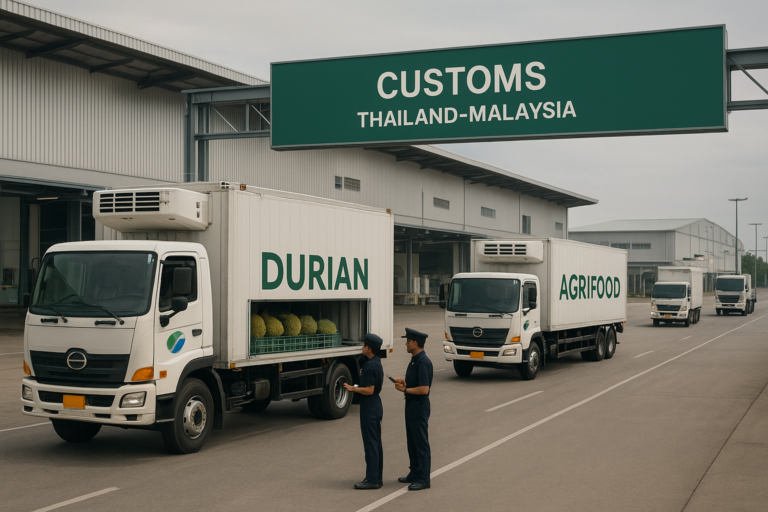
Executive Summary
The key signal is the emergence of Thailand as a critical transit hub for Malaysia’s durian exports, illustrating the deepening economic interconnectivity within ASEAN’s agricultural supply chains. This development signals Thailand’s expanding role in regional trade logistics, with implications extending beyond agriculture into cross-border commerce and infrastructure utilization.
For investors focused on Thailand, the prominence of Malaysia durian export through Thailand highlights opportunities in sectors benefiting from strengthened trade facilitation, such as logistics, transportation, and cold-chain infrastructure. It also underscores Thailand’s strategic position as a gateway for ASEAN intra-regional trade, reinforcing the country’s potential to enhance its value proposition in the agrifood export ecosystem.
Key Facts
- Malaysia has increasingly routed durian exports through Thailand’s logistic and transit channels.
- This routing leverages Thailand’s established transportation infrastructure and regional connectivity.
- The development reflects integrated supply chains within the ASEAN region focused on agricultural commodity flows.
Why It Matters
This development demonstrates Thailand’s evolving function beyond a domestic exporter to a regional logistics hub facilitating ASEAN agricultural commerce. The movement of Malaysian durian through Thailand channels signifies cost and time efficiencies gained by leveraging Thailand’s infrastructure capabilities, signaling deeper regional economic integration.
This is significant because it enhances Thailand’s trade corridor prominence, attracting investments in freight, warehousing, and cold-chain technologies. Moreover, it highlights the increasing importance of Thailand’s border trade policies and customs efficiency as determinants of ASEAN supply chain competitiveness.
Investment Implications
The facilitation of Malaysia durian export through Thailand translates into elevated demand for Thailand-based logistics services, including trucking, warehousing, and cold storage operators. Firms specializing in perishable goods handling are positioned to benefit from expanded cross-border trade volumes.
From a capital allocation perspective, infrastructure players involved in road transport networks and border customs technology may see intensified activity due to increased throughput. The focus on perishable agricultural exports heightens the relevance of advanced refrigeration and quality assurance technologies, potentially driving capital expenditure in the agrifood logistics segment.
This trade flow also presents a competitive advantage for Thailand’s trade corridors influencing investor sentiment around regional supply chain reliability versus other ASEAN transit pathways.
Sector Impact
Positive
- Logistics and Transportation: Enhanced cross-border trade volumes bolster demand for freight services, cold-chain logistics, and infrastructure utilization.
- Agriculture and Food Processing: Increased activity in preserving and distributing durian supports ancillary service providers in packaging, refrigeration, and quality control.
Neutral
- Retail and Wholesale: Although trade volume increase benefits supply, direct retail impact in Thailand is limited due to the transit nature of the trade.
Risk
- Customs and Regulatory Compliance: The efficiency and reliability of customs procedures are critical; any delays or policy inconsistencies could disrupt trade flows.
- Infrastructure Strain: Increased transit volumes may stress existing transportation networks and cold storage capacity if not managed timely.
Strategic Signals
This development signals Thailand’s strategic ambition to capitalize on its geographic and infrastructural strengths to become a regional trade facilitator. It suggests policy focus on enhancing cross-border trade efficiency and reinforces the integration of ASEAN supply chains anchored by Thailand’s transport corridors.
Second-order effects include heightened foreign investment interest in logistics infrastructure and technology, positioning Thailand as a linchpin in regional agribusiness value chains. The scenario implies that expansions or upgrades to customs facilitation, border management, and multimodal transport systems are increasingly relevant to sustain and grow these trade flows.
ASEAN Context
The Malaysia durian export through Thailand exemplifies deepening economic interdependence among ASEAN members, leveraging complementary strengths in agriculture and logistics. Thailand’s role as a transit hub enhances ASEAN’s collective supply chain resilience and market integration.
Given Thailand’s central location and infrastructure investments, this flow may influence regional trade patterns, encouraging further intra-ASEAN commodity movement optimization, supporting the ASEAN Economic Community goals.
Risks
Risks center primarily on operational execution at the Thailand-Malaysia border, including customs clearance efficiency and infrastructure capacity constraints. Any policy shifts or administrative bottlenecks could raise transportation costs and diminish Thailand’s attractiveness as a trade corridor.
Additionally, unexpected disruptions in transport infrastructure or cold-chain failures could affect commodity quality and increase indirect costs, potentially weakening investor confidence in logistics-dependent sectors.
Bottom Line
The use of Thailand as a transit route for Malaysia durian exports signals Thailand’s growing strategic importance in ASEAN’s agricultural supply chains and regional trade logistics. This development reinforces Thailand’s competitive edge in cross-border commerce infrastructure, providing targeted investment opportunities in logistics, cold-chain processing, and transport sectors. However, sustaining this role requires continuous efficiencies in customs processes and infrastructure capacity expansion to mitigate operational risks.
Complete Guide
For a broader investment framework, continue with the Thailand Macro Investment Guide 2026.
Thailand Investor Brief PRO
Want deeper institutional-grade Thailand market intelligence?
Thailand Investor Brief PRO delivers three daily briefings with strategic market analysis, investment implications, and ASEAN intelligence beyond the public news cycle.
Related Thailand Investment Intelligence
- Thailand vs Cambodia for Border Trade in 2026: Strategic Investment Perspectives
- Thailand vs Malaysia for Tourism Investment: Strategic Insights for 2026
Frequently Asked Questions
Why does this development matter for Thailand investors?
This development matters because it may affect Thailand’s investment environment through policy direction, sector exposure, trade dynamics, capital allocation, or ASEAN market positioning.
Which sectors could be affected?
The most relevant sectors depend on the specific development, but investors should assess exposure across policy-sensitive industries, financial services, trade-linked sectors, infrastructure, property, tourism, energy, and ASEAN-facing businesses.
How does this affect Thailand’s position in ASEAN?
The ASEAN impact depends on whether the development changes regional competitiveness, cross-border investment, supply chains, or investor sentiment. Thailand’s role should be assessed relative to nearby markets such as Singapore, Malaysia, Vietnam, Indonesia, and Cambodia.
What should investors watch next?
Investors should watch implementation details, policy follow-through, sector-level responses, corporate earnings signals, regulatory changes, and whether the development creates measurable shifts in demand, costs, or capital flows.