Executive Summary
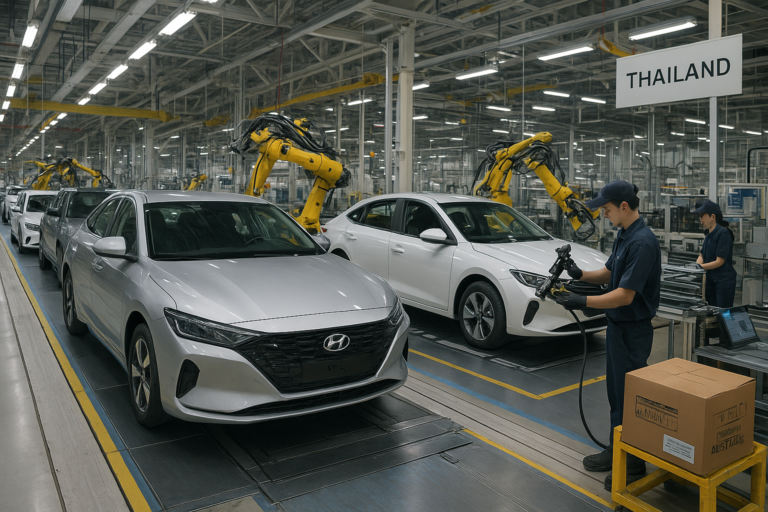
The key signal is Thailand’s rising importance as a regional hub for producing and exporting Hyundai battery electric vehicles (BEVs) to the Australian market. This development signals a strategic diversification of Thailand’s automotive export portfolio, moving beyond traditional internal combustion engine (ICE) vehicles towards electric mobility, aligning with global electrification trends. For investors, this highlights Thailand’s evolving role in the ASEAN automotive supply chain and its capacity to capture growing demand for BEVs in developed export markets.
This transition matters because it underscores Thailand’s competitive positioning in Southeast Asia’s automotive sector, particularly in emerging electric vehicle segments. The export link to Australia introduces Thailand as a critical node in the electric vehicle value chain, which may influence related sectors such as automotive components suppliers, logistics, and energy inputs. It could also attract capital inflows from investors focused on sustainable mobility and EV ecosystem development in ASEAN.
Key Facts
- Hyundai is exporting battery electric vehicles (BEVs) from Thailand to Australia.
- Thailand serves as a production and export base for Hyundai’s BEVs within the ASEAN region.
- The exports to Australia indicate Thailand’s capability to meet standards and demand in developed markets for electric vehicles.
Why It Matters
Thailand’s role as an export hub for Hyundai BEVs to Australia signals a strategic upgrade in its automotive industry from conventional ICE production to electric vehicle manufacturing. This shift reflects Thailand’s alignment with the global automotive industry’s transition towards electric mobility. It suggests improvements in Thailand’s production capabilities, supply chain sophistication, and regulatory environment to support advanced electric vehicle production.
The importance of Australia as an export destination lies in its developed market status and stringent automotive standards, implying that Thailand’s automotive manufacturing meets high-quality benchmarks. This enhances Thailand’s credibility as a manufacturing base for premium, technologically advanced vehicles, attracting further international automakers and suppliers seeking a foothold in ASEAN and Pacific Rim markets.
Investment Implications
Investors stand to gain insights into capital allocation opportunities in Thailand’s automotive and adjacent sectors. Increased BEV production and exports will impact the automotive supply chain, encouraging investment in electric vehicle components, battery technology, and logistics infrastructure. Moreover, companies involved in electricity generation and energy provisioning could see longer-term demand increases due to local production needs.
This export development could influence sector asset valuations, particularly for listed automotive parts manufacturers and logistics firms with exposure to Thailand’s export corridors. For foreign direct investors, Thailand’s proven capacity to produce export-grade BEVs offers a comparative advantage versus other ASEAN locations still ramping up EV manufacturing.
Sector Impact
Positive
- Automotive Manufacturing: Solidifies Thailand’s position as an EV production base, supporting industry upskilling and export diversity.
- Auto Parts Suppliers: Growth in BEV production drives demand for specialized EV components, battery packs, and electronic systems.
- Logistics and Export Services: Increasing exports to developed markets such as Australia bolster logistics providers servicing automotive supply chains.
Neutral
- Energy Sector: While electricity demand may rise from local production, broader impacts on Thailand’s national energy landscape remain limited at present.
- Financial Sector: Direct impact on cost of borrowing or risk perception is unclear without further data on financing or FDI scale.
Risk
- Automotive Sector: Exposure to demand fluctuations in Australia or global EV market cycles could introduce revenue volatility.
- Supply Chain Disruptions: Dependency on imported EV components or batteries could present logistical and cost risks if global supply chains tighten.
Strategic Signals
This development signals Thailand’s transition from being a volume-focused ICE vehicle exporter to a more technologically advanced EV production platform. It demonstrates the industry’s ability to integrate into higher value-added global supply chains aligned with sustainability trends. This enhances Thailand’s attractiveness for international automotive investments targeting ASEAN and Pacific markets.
Thailand’s manufacturing and export success with Hyundai BEVs to Australia also signals growing regional supply chain integration with developed economies, solidifying Thailand’s strategic export diversification beyond traditional markets. The capacity to meet Australia’s regulatory and quality standards is a testament to Thailand’s maturing industrial ecosystem capable of supporting next-generation vehicles.
ASEAN Context
This development appears primarily domestic in nature with limited immediate ASEAN-wide implications.
Risks
Execution risks include scaling production efficiently while maintaining quality standards demanded by Australian and other developed markets. Potential supply chain vulnerabilities exist, especially regarding critical battery components and raw materials, since disruptions could affect production schedules and cost structures.
Market risks stem from evolving regulatory frameworks and EV market demand trends in Australia and globally. A slowdown in BEV adoption or changes in trade policies could dampen export growth. Additionally, competition from other ASEAN countries increasingly focusing on EV production presents longer-term competitive risks.
Bottom Line
Thailand’s emergence as a production and export hub for Hyundai battery electric vehicles to Australia underscores its strategic evolution in automotive manufacturing. This development enhances Thailand’s position in the global EV supply chain, indicating increased sector sophistication and export diversification. Investors and executives should view this as evidence of Thailand’s growing capability to serve premium electric vehicle markets and attract related investments. Near-term risks are primarily linked to supply chain dependencies and external EV market demand dynamics.
Complete Guide
For a broader investment framework, continue with the Thailand Macro Investment Guide 2026.
Thailand Investor Brief PRO
Want deeper institutional-grade Thailand market intelligence?
Thailand Investor Brief PRO delivers three daily briefings with strategic market analysis, investment implications, and ASEAN intelligence beyond the public news cycle.
Related Thailand Investment Intelligence
- Thailand Manufacturing Output 2026: Strategic Signals for Investors
- Thailand vs Indonesia for Battery Investment in 2026: Strategic Insights for Investors
- Thailand vs Vietnam for Electronics Manufacturing in 2026: Strategic Insights for Investors
Frequently Asked Questions
Why does this development matter for Thailand investors?
This development matters because it may affect Thailand’s investment environment through policy direction, sector exposure, trade dynamics, capital allocation, or ASEAN market positioning.
Which sectors could be affected?
The most relevant sectors depend on the specific development, but investors should assess exposure across policy-sensitive industries, financial services, trade-linked sectors, infrastructure, property, tourism, energy, and ASEAN-facing businesses.
How does this affect Thailand’s position in ASEAN?
The ASEAN impact depends on whether the development changes regional competitiveness, cross-border investment, supply chains, or investor sentiment. Thailand’s role should be assessed relative to nearby markets such as Singapore, Malaysia, Vietnam, Indonesia, and Cambodia.
What should investors watch next?
Investors should watch implementation details, policy follow-through, sector-level responses, corporate earnings signals, regulatory changes, and whether the development creates measurable shifts in demand, costs, or capital flows.