Executive Summary
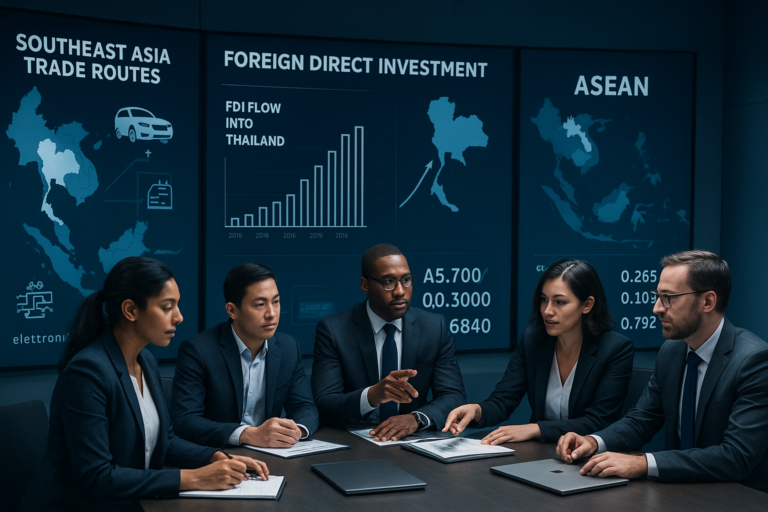
The key signal is that recent developments in Thailand trade and investment reflect a pivotal phase in the country’s macroeconomic positioning, highlighting shifts in export composition and foreign direct investment trends. This evolution signals nuanced changes in Thailand’s economic resilience and structural adaptability, which are material for investors assessing sectoral allocation and risk exposure.
For investors, the deeper importance lies in how these trade and investment patterns recalibrate Thailand’s integration within regional and global value chains, affecting currency stability, export-driven earnings, and capital inflows. Understanding this context translates into better predictive insight on sectors sensitive to trade cycles and investment sentiment, such as manufacturing export hubs and infrastructure-linked enterprises.
Key Facts
- Thailand’s trade volumes indicate alteration in export categories and trading partners.
- Foreign direct investment inflows show shifts in sectoral focus and geographic origin.
- The Thai baht demonstrates sensitivity to trade and investment flows amid external economic pressures.
- Trade and investment data reveal evolving supply chain realignments within ASEAN and with major partners.
Why It Matters
The changing landscape of Thailand trade and investment signals a material shift in the country’s economic drivers and external demand exposure. For example, shifts in export composition could affect Thailand’s vulnerability to sector-specific global shocks, influencing exporter revenue volatility and currency valuation.
Foreign direct investment patterns offer forward-looking insights into which sectors or projects are attracting capital, directly impacting Thailand’s industrial base and long-term productivity trends. This, in turn, affects corporate earnings expectations and debt servicing capacities of companies reliant on international capital.
These dynamics also influence Thailand’s fiscal and monetary environments indirectly by affecting tax revenues and foreign exchange reserves, which are critical underpinnings for broader macroeconomic stability and sovereign risk assessments.
Investment Implications
Administrators of capital and executives need to recalibrate risk premia and sector weights in portfolios to reflect Thailand’s shifting trade and investment profile. Export-exposed companies, particularly in manufacturing and electronics, might exhibit varying earnings resilience depending on the nature of the trade partners and product mix.
Capital-intensive sectors aligned with foreign direct investment trends should be analyzed for potential capitalization benefits or cost pressures arising from currency fluctuations and supply chain adjustments. Foreign investor sentiment, influenced by these flows, could also affect equity valuations and bond spreads.
Additionally, companies involved in import-dependent inputs might experience cost structure volatility due to external trade shifts affecting currency and trade terms, impacting operational margins and investment returns.
Sector Impact
Positive
- Manufacturing Exports: Shifts in trading partners and product demand suggest opportunities for diversification and upgrading, supporting segments tied to technology and automotive exports.
- Infrastructure and Logistics: Enhanced foreign investment focus on infrastructure could drive growth prospects in logistics, port, and transport sectors, underpinning export capacity.
Neutral
- Consumer Goods: Limited direct impact as these sectors are more domestically oriented, although export market shifts might moderate input costs indirectly.
Risk
- Energy Importers: Changes in trade balance and currency pressure could elevate costs for energy-intensive industries reliant on imported fuels, affecting margins.
- Financial Services: Increased volatility in capital flows and exchange rates may pose credit and market risks for financial institutions with trade-linked exposures.
Strategic Signals
This development signals Thailand’s ongoing navigation through global economic restructuring characterized by supply chain diversifications and shifting FDI patterns. The adaptability in trade and investment flows reflects Thailand’s efforts to maintain its competitive attractiveness amid intensifying ASEAN and regional competition.
Second-order effects include potential realignment in Thailand’s production ecosystems, possibly accelerating internal value chain integration or necessitating upgrades in infrastructure and technology to sustain export-led growth.
Moreover, these shifts could recalibrate policy focus toward reinforcing sectors that secure stable capital inflows and durable export earnings, influencing investment climate and regulatory priorities.
ASEAN Context
Thailand’s trade and investment realignments occur within an intensified ASEAN competitive environment where regional supply chain reconfiguration is ongoing. Thailand’s ability to attract diversified FDI and maintain export relevance affects its relative positioning against neighbors vying for manufacturing and logistics prominence.
Changes in Thailand’s trade composition and investment appeal have implications for ASEAN’s internal trade patterns and infrastructure development initiatives, impacting broader regional economic integration efforts.
Risks
Key risks include potential interruptions to trade flows caused by geopolitical tensions or global economic slowdowns that disproportionately affect certain export segments. A concentrated shift in FDI by origin or sector could expose Thailand to sudden capital retractions.
Currency volatility could increase borrowing costs for companies with foreign-denominated debt, reducing flexibility for investment or expansion plans. Additionally, slower-than-expected adaptation of infrastructure to support evolving trade and investment could constrain growth prospects.
Bottom Line
The evolution in Thailand trade and investment patterns signals a transition phase with significant implications for export composition, foreign capital dynamics, and sectoral performance. Investors must factor these nuanced shifts into their macroeconomic assessments and portfolio positioning.
Thailand’s competitive positioning in ASEAN and integration into global value chains remains contingent on managing these trade and investment evolutions effectively. This analysis underscores the need for a sector-specific lens grounded in observable trade and capital flow dynamics.
Thailand Investor Brief
Stay Ahead of Thailand and ASEAN Markets
Explore Thailand Signal Capital’s flagship investor intelligence service,
including free market insights and premium daily briefings for investors,
executives, entrepreneurs, and ASEAN-focused professionals.
- Thailand and ASEAN market intelligence
- Investment implications and strategic signals
- FREE and PRO briefing options
Frequently Asked Questions
Why does this development matter for Thailand investors?
This development matters because it may affect Thailand’s investment
environment through policy direction, sector exposure, trade dynamics,
capital allocation, or ASEAN market positioning.
Which sectors could be affected?
The most relevant sectors depend on the specific development, but investors
should assess exposure across policy-sensitive industries, financial
services, trade-linked sectors, infrastructure, property, tourism, energy,
and ASEAN-facing businesses.
How does this affect Thailand’s position in ASEAN?
The ASEAN impact depends on whether the development changes regional
competitiveness, cross-border investment, supply chains, or investor
sentiment. Thailand’s role should be assessed relative to nearby markets
such as Singapore, Malaysia, Vietnam, Indonesia, and Cambodia.
What should investors watch next?
Investors should watch implementation details, policy follow-through,
sector-level responses, corporate earnings signals, regulatory changes,
and whether the development creates measurable shifts in demand, costs,
or capital flows.
Complete Guide
For a broader investment framework, continue with the Thailand Tourism Investment Guide 2026.