Executive Summary
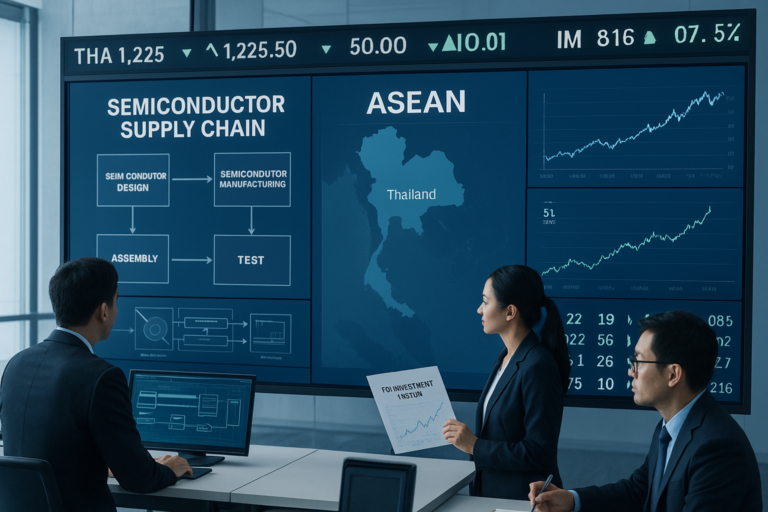
The key signal is the deepening integration of Thailand’s stock markets with the semiconductor supply chain expansion and foreign direct investment (FDI) inflows. This indicates an acceleration in the country’s role as a critical node in global and regional technology manufacturing networks, particularly amidst heightened demand for semiconductor resilience and supply chain diversification. For investors, this development elevates Thailand’s strategic significance, linking capital markets with the underlying industrial transformation driven by technology sectors.
This evolution matters because it signals a structural shift in Thailand’s capital markets toward exposure to high-growth semiconductor-related enterprises and associated industrial segments. The resultant amplification of foreign investment interest in listed companies tied to semiconductor supply chains and technology manufacturing points to a re-rating potential and altered sector composition in domestic equity markets. Additionally, it underlines a broader reallocation of FDI within ASEAN, with Thailand positioning itself as a competitive hub in this strategically important sector.
Thailand stock markets reflect an increased visibility of tech-driven supply chain capital flows and operational footprints. This connectivity translates into specific economic and business implications for sectors aligned with electronics, industrial manufacturing, and capital goods. Furthermore, it highlights second-order effects on market liquidity, investor composition, and corporate investment strategies, necessitating nuanced understanding from institutional investors and market participants targeting Thailand and ASEAN themes.
Key Facts
- Thailand’s stock markets exhibit growing participation from semiconductor-related companies and supporting manufacturing sectors.
- Foreign direct investment inflows show an upward trajectory linked with high-tech and semiconductor supply chain development.
- The expansion of semiconductor supply chains in Thailand is correlated with increased capital market activity focused on technology and industrial segments.
- Thailand remains a significant ASEAN player in attracting semiconductor-related FDI relative to regional peers.
- Market capitalization and trading volumes in sectors linked to electronics manufacturing display notable growth patterns.
Why It Matters
The increased prominence of semiconductor supply chains within Thailand’s stock markets reflects a material shift in the country’s industrial transformation and capital market dynamics. This inflection matters because it translates into heightened exposure for the Thai equity market to a globally strategic sector characterized by strong growth and geopolitical importance. For the economy, this development signals a transition from traditional manufacturing toward higher value-added activities with complex supply chain integration.
From a business perspective, companies operating within or adjacent to semiconductor supply chains are likely to experience increased investor scrutiny and capital allocation, impacting corporate financing, valuation benchmarks, and strategic partnerships. The Thailand stock markets’ integration with this ecosystem also implies a diversification and sophistication of listed sectors, reducing dependency on cyclical commodities and broadening market appeal to technology-focused investors.
Regionally, this development reinforces Thailand’s position within ASEAN as a key beneficiary of semiconductor supply chain realignments. This asserts the country’s competitive advantage in attracting FDI centered on advanced manufacturing, which is vital amid global efforts to secure resilient and diversified supply chains. Hence, Thailand’s capital markets are increasingly intertwined with these macro-structural themes.
Investment Implications
For investors, the growing representation of semiconductor-linked industries in Thailand stock markets implies a revised risk-reward profile, where technology-driven growth potential intersects with sector-specific volatility and geopolitical sensitivities. Capital allocation strategies may increasingly prioritize Thai equities exposed to semiconductor inputs, production, and related services, reflecting secular demand trends.
Market participants should consider the evolving corporate earnings profiles influenced by semiconductor cycle dynamics, supply constraints, and technological innovation pace. Foreign investors, in particular, may find enhanced opportunities tied to FDI-fueled expansion, contributing to liquidity and valuation support for related stocks.
Capital markets will likely see more corporate actions, including equity issuance linked to capacity expansion in semiconductor and technology sectors, thereby affecting listed company capital structures and investor returns. This also underscores the potential for increased cross-border capital flows targeting Thailand as a strategic manufacturing base and financial investment destination within ASEAN.
Sector Impact
Positive
- Technology and Electronics Manufacturing: Enhanced investment flows and market visibility driven by semiconductor supply chain development facilitate capacity growth and valuation uplifts.
- Capital Goods and Industrial Machinery: Rising demand for equipment supporting high-tech manufacturing increases business prospects and investor interest.
Neutral
- Financials: Banking and capital markets infrastructure benefit indirectly from increased corporate financing activity, but impact remains secondary.
Risk
- Commodity and Traditional Manufacturing Sectors: Potential relative underperformance as capital shifts toward technology-focused segments; market volatility may increase due to semiconductor cycle sensitivities.
Strategic Signals
This development signals Thailand’s strategic reorientation within global supply chains towards higher-value, technology-driven industries reflected both in production and capital market composition. It underscores an evolving market structure where emissions of foreign direct investment and listed company profiles gravitate around semiconductor manufacturing and related complex electronics—a sign of maturation and industrial sophistication.
It also reflects Thailand’s shifting competitive positioning within ASEAN, as supply chain diversification accelerates globally. The ability of the stock markets to absorb and reflect these economic undercurrents suggests increased integration between financial markets and industrial transformation, enabling capital allocation aligned with emerging sectoral prominence.
Second-order effects likely include elevated cross-border investor engagement, amplified capital market liquidity in technology segments, and heightened corporate governance focus to meet international investor standards within complex manufacturing sectors.
ASEAN Context
The increased semiconductor supply chain activity connected with Thailand’s stock markets reinforces the country’s role as a central ASEAN hub amid regional efforts to diversify technology manufacturing. This development complements supply chain realignments occurring across ASEAN, where countries compete to attract foreign direct investment in high-tech sectors.
Thailand’s competitive advantages in infrastructure, skilled labor, and market depth contribute to its positioning, making it a preferred destination relative to regional peers. This enhances Thailand’s appeal not only as a production base but also as a financial market center supporting sector growth, potentially influencing ASEAN-wide capital flow patterns.
Risks
Key risks include semiconductor cycle volatility, which may induce sharp fluctuations in corporate earnings and equity valuations within relevant sectors. Dependence on global supply-demand conditions exposes Thailand’s markets to external shocks, including geopolitical tensions affecting semiconductor supply chains.
Execution risks related to sustaining and expanding FDI inflows persist, including potential shifts in global trade policies or disruptions in supply chain realignment trends. Capital market risk involves possible liquidity mismatches if investor expectations oscillate rapidly with semiconductor sector news flow.
Finally, the absence of detailed source information limits granularity on policy, regulatory, or infrastructural initiatives that might shape the pace and scope of semiconductor-linked capital market integration.
Bottom Line
Thailand’s stock markets are increasingly reflecting the country’s integration with semiconductor supply chains and foreign direct investment inflows, highlighting a structural transition toward technology-driven equity exposures. This elevates Thailand’s profile as a strategic node in ASEAN for high-tech manufacturing and capital allocation. Investors and executives should consider the sector-specific growth dynamics and associated risks underpinning this evolution. The development signals a maturing market landscape where capital markets and industrial upgrading coalesce, shaping Thailand’s investment narrative within ASEAN.
Thailand Investor Brief
Stay Ahead of Thailand and ASEAN Markets
Explore Thailand Signal Capital’s flagship investor intelligence service,
including free market insights and premium daily briefings for investors,
executives, entrepreneurs, and ASEAN-focused professionals.
- Thailand and ASEAN market intelligence
- Investment implications and strategic signals
- FREE and PRO briefing options
Frequently Asked Questions
Why does this development matter for Thailand investors?
This development matters because it may affect Thailand’s investment
environment through policy direction, sector exposure, trade dynamics,
capital allocation, or ASEAN market positioning.
Which sectors could be affected?
The most relevant sectors depend on the specific development, but investors
should assess exposure across policy-sensitive industries, financial
services, trade-linked sectors, infrastructure, property, tourism, energy,
and ASEAN-facing businesses.
How does this affect Thailand’s position in ASEAN?
The ASEAN impact depends on whether the development changes regional
competitiveness, cross-border investment, supply chains, or investor
sentiment. Thailand’s role should be assessed relative to nearby markets
such as Singapore, Malaysia, Vietnam, Indonesia, and Cambodia.
What should investors watch next?
Investors should watch implementation details, policy follow-through,
sector-level responses, corporate earnings signals, regulatory changes,
and whether the development creates measurable shifts in demand, costs,
or capital flows.
Complete Guide
For a broader investment framework, continue with the Thailand Tourism Investment Guide 2026.