Executive Summary
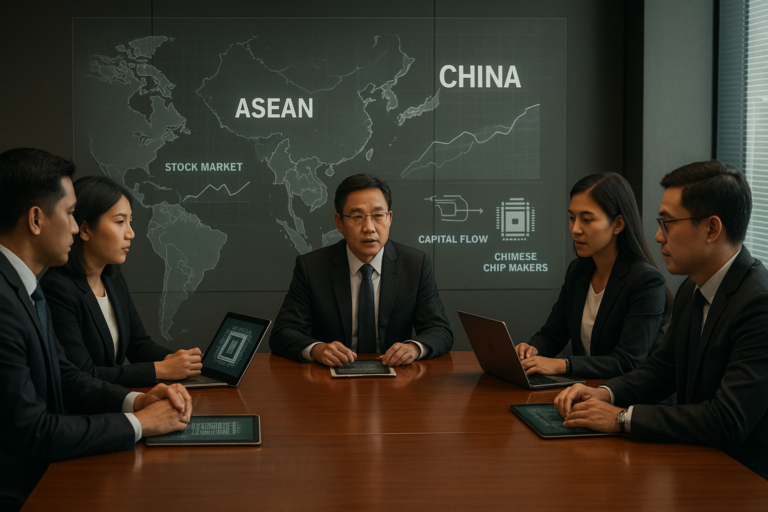
The key signal is the CXMT IPO as an indicator of intensifying regional competition and capacity expansion within the ASEAN chip industry, highlighting China’s deepening footprint and the strategic significance of semiconductor production in Southeast Asia. For investors with interests in Thailand and the broader ASEAN semiconductor landscape, this development underscores the accelerating technological value chain shifts that may influence capital flows, supply chains, and market positioning in the region.
This event matters because it signals a concrete market response to global semiconductor demand pressures and supply chain recalibration efforts. The CXMT IPO reveals how chip manufacturing is evolving into a competitive battleground with implications for ASEAN economies, including Thailand, which must navigate increasingly complex regional dynamics. Understanding these shifts is essential for investment decision-making, particularly regarding exposure to sectors linked to electronics manufacturing, tech exports, and industrial real estate.
Key Facts
- CXMT, a Chinese memory chip manufacturer, has launched an initial public offering (IPO), marking a significant expansion in its capital base.
- The chip industry continues to experience robust demand driven by electronics, data centers, and automotive sectors.
- The IPO reflects increased investor appetite for semiconductor companies positioned for growth amid global supply chain adjustments.
Why It Matters
The CXMT IPO is not merely a capital market event but a strategic signal of intensified competition in the semiconductor ecosystem within ASEAN’s geographic and economic orbit. This development indicates that China is doubling down on domestic chip manufacturing capabilities, leveraging capital markets to support technology upgrading and capacity expansion. For Thailand, a country deeply embedded in global electronics supply chains, the IPO crystallizes the urgent need to assess how rising regional chip manufacturing capabilities might shift export dynamics, technology partnerships, and foreign investment flows.
Given Thailand’s reliance on electronics and automotive component exports, the growth of players like CXMT in proximal markets could alter regional supply chains, putting pressure on local manufacturers to innovate or specialize further. Furthermore, the IPO highlights how capital markets regard semiconductor sector assets in ASEAN as growth engines, potentially increasing competition for investment capital among regional markets including Thailand.
Investment Implications
From an investment perspective, the CXMT IPO suggests an evolving landscape where semiconductor manufacturing capacity and technological sophistication become critical differentiators. Investors should note that Thailand’s industrial ecosystem may face heightened competition for raw materials, specialist labor, and technology partnerships as regional neighbors expand their chip production capabilities.
For asset allocation, funds exposed to ASEAN technology and manufacturing sectors must now factor in increased capital concentration in Chinese semiconductor firms. This could intensify capital inflows toward China-based chip producers, possibly constraining investment in Thailand’s related sectors and diverting innovation-focused partnerships and supply chain contracts.
Moreover, business executives managing Thailand’s factories and export hubs might need to anticipate structural shifts in demand for electronics components, influenced by China’s largescale capacity boost. To maintain competitive positioning, Thai companies may need to accelerate product upgrading and explore deeper integration with next-generation semiconductor value chains.
Sector Impact
Positive
- Technology Manufacturing: Stimulates innovation pressure, potentially catalyzing product upgrading and value-chain migration among Thai manufacturers.
Neutral
- Financial Markets: IPO itself unlikely to directly shift Thailand’s capital markets but signals investor appetite for technology sector exposure.
Risk
- Electronics Exports: Increased competition from regional semiconductor capacity expansion may compress margins and market share for Thai exporters.
- Industrial Property: Potential reallocation of foreign direct investment towards jurisdictions with larger-scale chip manufacturing investments.
Strategic Signals
The CXMT IPO signals an acceleration of regional semiconductor capacity-building and capital market integration. Thailand’s position as an electronics manufacturing base is subject to increased technological competition from emerging chip producers in nearby China. This intensifies the imperative to deepen industrial upgrading and attract sophisticated capital inflows linked to emerging technologies.
Additionally, the IPO underscores the growing intersection between capital markets and high-tech manufacturing in the region, suggesting a structural shift where access to financing will be pivotal for countries aiming to secure roles in the semiconductor supply chain. Thailand’s future positioning will depend on how effectively it can leverage its existing manufacturing infrastructure to attract downstream semiconductor investments or niche segments less susceptible to cost pressure.
ASEAN Context
This development highlights China’s strategic expansion in semiconductor manufacturing with direct competitive implications for ASEAN regional markets, including Thailand. While the IPO itself is a Chinese corporate event, the resultant capacity growth impacts ASEAN supply chains, investment competition, and regional value chain integration patterns.
For ASEAN policymakers and investors, CXMT’s IPO serves as a reminder that maintaining regional relevance in the semiconductor sector requires coherent industrial policy and competitive investment environments to counterbalance China’s scale advantage.
Risks
- Execution Risk: Thailand may struggle to attract parallel large-scale semiconductor investments given China’s dominant capital positioning post-IPO.
- Market Risk: Increased semiconductor supply capacity may lead to price competition, squeezing downstream manufacturers in Thailand’s export base.
- Capital Flow Risk: Shift of investment focus toward China’s chip companies could reduce available financing for Thai technology ventures.
Bottom Line
The CXMT IPO acts as a directional indicator of China’s expanding semiconductor footprint with palpable implications for ASEAN’s chip industry landscape. For Thailand, the event signals heightened competitive pressures and evolving capital market dynamics that shape investment, technology upgrading, and export competitiveness. Market participants must consider these structural shifts when assessing longer-term sector exposure and positioning within Southeast Asia’s increasingly contested semiconductor value chains.
Thailand Investor Brief
Stay Ahead of Thailand and ASEAN Markets
Explore Thailand Signal Capital’s flagship investor intelligence service,
including free market insights and premium daily briefings for investors,
executives, entrepreneurs, and ASEAN-focused professionals.
- Thailand and ASEAN market intelligence
- Investment implications and strategic signals
- FREE and PRO briefing options
Frequently Asked Questions
Why does this development matter for Thailand investors?
This development matters because it may affect Thailand’s investment
environment through policy direction, sector exposure, trade dynamics,
capital allocation, or ASEAN market positioning.
Which sectors could be affected?
The most relevant sectors depend on the specific development, but investors
should assess exposure across policy-sensitive industries, financial
services, trade-linked sectors, infrastructure, property, tourism, energy,
and ASEAN-facing businesses.
How does this affect Thailand’s position in ASEAN?
The ASEAN impact depends on whether the development changes regional
competitiveness, cross-border investment, supply chains, or investor
sentiment. Thailand’s role should be assessed relative to nearby markets
such as Singapore, Malaysia, Vietnam, Indonesia, and Cambodia.
What should investors watch next?
Investors should watch implementation details, policy follow-through,
sector-level responses, corporate earnings signals, regulatory changes,
and whether the development creates measurable shifts in demand, costs,
or capital flows.
Complete Guide
For a broader investment framework, continue with the Thailand Tourism Investment Guide 2026.