Executive Summary
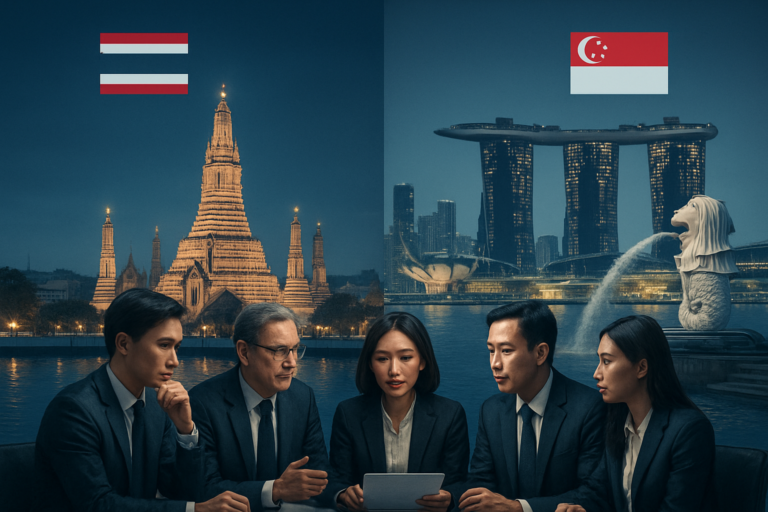
The decision between Thailand vs Singapore regional headquarters involves assessing infrastructure robustness, supply chain integration, and operational resilience within an ASEAN context. Thailand offers a strategic manufacturing and logistics base with evolving industrial ecosystems, while Singapore provides a highly developed infrastructure, superior connectivity, and a well-established business environment facilitating regional management.
From a structural perspective, Thailand appeals to investors prioritizing cost-efficient operations, scalable manufacturing linkages, and growing market access to Greater Mekong and ASEAN economies. Singapore’s strength lies in its streamlined regulatory environment, world-class logistics hubs, and a concentration of professional services suited for knowledge-intensive regional headquarters.
Investors should weigh trade-offs between Thailand’s cost and supply chain density advantages against Singapore’s infrastructure maturity and regulatory predictability. Monitoring ongoing infrastructure developments and regional integration policies will be crucial for geographically distributing ASEAN headquarters intelligently.
Key Facts
- Economy: Thailand has a diversified manufacturing base and robust domestic market; Singapore’s service-oriented economy leads in finance, logistics, and headquarters functions.
- Regulation: Singapore is known for streamlined ease of doing business and regulatory predictability; Thailand exhibits gradual reforms with some regulatory complexities.
- Infrastructure: Singapore offers global-standard airport, seaports, and digital infrastructure; Thailand’s infrastructure is improving, supported by strategic investments but with regional disparities.
- Costs: Thailand generally offers lower operating and labor costs; Singapore’s costs are higher, reflecting developed market status.
- Investment Climate: Singapore features strong protection of investor rights; Thailand is improving incentives but with variable regulatory enforcement.
- Market Access: Thailand provides gateway access to the mainland ASEAN and CLMV countries; Singapore serves as a global hub with extensive connectivity.
- Workforce: Thailand has a large semi-skilled workforce expanding in technical skills; Singapore has a highly skilled, multilingual workforce.
- Foreign Ownership: Singapore permits full foreign ownership in most sectors; Thailand has some foreign ownership restrictions, varying by industry.
Comparison Analysis
The choice between Thailand and Singapore for establishing a regional headquarters hinges on infrastructure reliability, supply chain depth, labor quality, and the regulatory framework supporting scalability and operational control.
Singapore’s advanced infrastructure and logistics efficiency support a centralized ASEAN headquarters focused on corporate governance, finance, and high-value services. Thailand’s strengths are more pronounced in manufacturing ecosystems, cost-effective logistics, and proximity to larger ASEAN mainland markets, favoring operational bases with regional production and distribution elements.
Operational resilience is a crucial consideration. Singapore’s position as a global trade hub provides stable access to international markets, while Thailand’s expanding infrastructure and growing supplier networks create opportunities for vertically integrated regional operations.
| Factor | Thailand | Singapore |
|---|---|---|
| Economy | Diversified manufacturing & domestic market | Service-oriented with global financial hub |
| Market Size | Larger domestic & regional ASEAN proximity | Smaller domestic market, global gateway |
| Infrastructure | Improving, regional disparities remain | World-class, well integrated |
| Taxation | Competitive, but complex incentives | Transparent, efficient tax systems |
| Regulation | Gradually reforming, some opacity | Highly predictable and streamlined |
| Logistics | Growing ports & networks, some bottlenecks | Top-tier ports & air cargo facilities |
| Labour | Large semi-skilled, rising technical skills | Highly skilled, multilingual workforce |
| Competitiveness | Cost and supply chain depth | Operational efficiency and services |
| Investment Incentives | Targeted industrial incentives | Broad, transparent incentives |
| Supply Chains | Strong regional supplier base | Integrated global supply networks |
| Political Stability | More variable | Stable and predictable |
| ESG Readiness | Developing frameworks | Advanced ESG integration |
| Skilled Labour | Growing pool | Established talent pool |
| Industrial Clusters | Automotive, electronics, agribusiness | Finance, logistics, biotech clusters |
These comparisons highlight that Thailand presents structural advantages for manufacturing-linked RHQs with cost sensitivity, while Singapore caters better to knowledge-intensive RHQs requiring global connectivity and regulatory efficiency. This reflects divergent investor profiles and strategic ambitions within ASEAN.
Capital allocation decisions should consider the intended role of the regional headquarter—whether primarily operational or strategic—and the evolving regional integration landscapes that impact supply chain resilience and market outreach.
Decision Framework
Investors prioritising infrastructure excellence, skilled talent availability, and mature industrial ecosystems may find Singapore better suited for regional headquarters focused on strategic control, finance, and sophisticated governance. Singapore’s business environment reduces execution risks and enhances operational responsiveness within ASEAN and globally.
Those prioritising cost efficiencies, manufacturing linkages, and scalable regional supply chains may lean towards Thailand, especially if the operational footprint requires proximity to expanding mainland ASEAN markets and integrated production clusters. Thailand fits investors with longer time horizons willing to navigate evolving regulatory environments.
Investors with a profile emphasizing advanced services, legal certainty, and seamless cross-border operations align more closely with Singapore regional headquarters. Conversely, companies seeking operational scale, competitive cost bases, and participation in regional manufacturing ecosystems align with Thailand regional headquarters.
Mission-critical infrastructure projects or reforms in Thailand’s logistics and supply chain could shift the balance if realized effectively. Similarly, shifts in Singapore’s economic openness or regional integration policies could alter investment calculus.
Investment Implications
Companies valuing operational cost containment and market proximity across ASEAN’s mainland countries may benefit from Thailand’s expanding industrial clusters and improving infrastructure, especially for supply chain, manufacturing, and logistics hubs anchored at a regional level.
Conversely, Singapore’s robust infrastructure, high ESG standards, and efficient regulatory framework favor investors focusing on headquarters functions such as regional strategy, finance, and corporate services, with an emphasis on resilience and compliance.
Capital allocations should factor in Thailand’s regulatory landscape and infrastructure ongoing development, monitoring policy reforms that impact foreign ownership and investment protections. Singapore’s premium cost base requires clear justification through operational efficiencies or strategic imperatives.
Long-term positioning within ASEAN must weigh regional integration trajectories, infrastructure connectivity, and talent availability, as both countries play complementary roles within a diversified ASEAN headquarters strategy.
Sector Impact
Manufacturing
Thailand’s manufacturing sector, focused on automotive, electronics, and agribusiness, provides a foundational ecosystem for regional headquarters requiring supply chain integration and production proximity. Singapore’s manufacturing footprint is limited, positioning it more as a service hub than production base.
Logistics
Singapore boasts top-tier ports and airport cargo facilities, offering unmatched logistics efficiency critical for headquarters managing international supply chains. Thailand’s logistics sector is improving with strategic investments in ports and transport networks, enhancing regional distribution but with some infrastructure gaps remaining.
Digital Economy
Singapore leads in digital infrastructure and connectivity, supporting advanced headquarters functions and digital services. Thailand’s digital economy is developing, with opportunities to improve ASEAN regional connectivity and digital services supporting operational functions.
Strategic Signals
Structural trends underscore Singapore’s sustained investment in infrastructure and regulatory modernization bolstering its role as a regional headquarters hub. Thailand’s policy focus on infrastructure upgrades and industrial cluster development signals intent to enhance its regional operational appeal.
Investment signals indicate rising interest in Thailand for export-oriented production and regional supply chain functions, while Singapore remains a premier destination for corporate services and knowledge-intensive regional management.
Competitiveness trajectories suggest both countries will continue complementing each other within ASEAN, with Singapore anchoring high-value HQs and Thailand facilitating integrated regional operations.
ASEAN Context
ASEAN integration initiatives enhance cross-border investment opportunities, promoting multi-hub regional headquarters models that leverage Singapore’s connectivity and Thailand’s manufacturing base. Regional supply chains increasingly span ASEAN countries, making multi-location investment strategies salient.
Foreign direct investment flows continue to favour Singapore for corporate and financial hubs, while Thailand attracts manufacturing-related FDI. Cross-border investment collaborations hinge on infrastructure linkages and regulatory harmonization within ASEAN frameworks.
Competitive dynamics will evolve as other ASEAN countries upgrade capabilities, requiring investors to maintain adaptive regional strategies.
Risks
Regulatory risk remains higher in Thailand due to evolving policies and foreign ownership restrictions, while Singapore offers regulatory predictability. Political risk is moderate in Thailand, with occasional instability, versus Singapore’s stable environment.
Currency risk is more pronounced in Thailand, potentially impacting costs and returns. ESG risk is developing in Thailand, with less mature compliance frameworks compared to advanced Singaporean standards.
Execution risk in Thailand may arise from infrastructure gaps and governance inconsistencies; Singapore’s execution risk is generally lower due to mature institutions.
Macro risks linked to global trade shifts and regional integration policies warrant ongoing monitoring in both jurisdictions.
Decision Scorecard
| Criteria | Thailand | Singapore |
|---|---|---|
| Infrastructure Readiness | Developing | Strong |
| Labour Cost Advantage | Strong | Less Suitable |
| Skilled Labour Availability | Moderate | Strong |
| Logistics Efficiency | Moderate | Strong |
| Investment Incentives | Moderate | Strong |
| Regulatory Predictability | Developing | Strong |
| Supply Chain Depth | Strong | Moderate |
| Long-Term Strategic Fit | Moderate | Strong |
This scorecard indicates Thailand is well-suited for investors prioritizing cost efficiency and operational supply chain integration within ASEAN’s mainland, particularly in manufacturing and logistics functions. Singapore is best suited for investors requiring regulatory certainty, infrastructure excellence, and access to highly skilled labor for regional governance and service functions.
Investors seeking a reliable, mature environment for headquarters functions will find Singapore more suitable, while those emphasizing scalable, cost-advantaged operational bases may prefer Thailand, contingent on evolving infrastructure and regulatory improvements.
Bottom Line
Thailand appears better suited for investors prioritizing cost-effective manufacturing and logistics hubs supporting regional operations, especially those targeting the ASEAN mainland market and willing to engage with ongoing infrastructure development and regulatory evolution.
Singapore is the preferred choice for investors focused on establishing regional headquarters that require sophisticated infrastructure, high regulatory predictability, and access to a skilled, multilingual workforce for corporate governance, finance, and service coordination.
Institutional investors and regional expansion teams should monitor infrastructure improvements, regulatory reforms, and ASEAN integration progress closely before allocating capital, recognizing the complementary roles and evolving nature of both Thailand and Singapore within the region’s headquarters ecosystem.
Thailand Investor Brief
Stay Ahead of Thailand and ASEAN Markets
Explore Thailand Signal Capital’s flagship investor intelligence service,
including free market insights and premium daily briefings for investors,
executives, entrepreneurs, and ASEAN-focused professionals.
- Thailand and ASEAN investment intelligence
- Decision-oriented market and policy analysis
- FREE and PRO briefing options
Related Thailand Investment Intelligence
- Thailand Automotive Exports Signal Growth in Hyundai BEV Supply Chain for Australia
- Thailand vs Vietnam: Which Is Better for Manufacturing Investment: Infrastructure and Supply Chain Comparison
- Thailand EV Manufacturing Supply Chains: Strategic Policy Signals and Investment Implications
- Best ASEAN Country for Manufacturing Investment: Costs, Incentives and Investor Returns
Frequently Asked Questions
Is Thailand a better investment destination than Singapore?
Thailand may be more attractive for some investors, while Singapore may offer advantages for others. The right choice depends on sector, risk tolerance, cost structure, market access needs, regulatory exposure, and long-term ASEAN strategy.
What are the main differences between Thailand and Singapore for investors?
The main differences usually involve policy direction, operating costs, infrastructure depth, workforce availability, sector maturity, foreign ownership rules, supply chain positioning, and exposure to regional demand.
Which sectors are most relevant in this comparison?
The most relevant sectors depend on the topic, but common areas include Manufacturing, Energy, Property, Tourism, Banking, Fintech, Infrastructure, Logistics, Exports, and ASEAN Supply Chains.
How should foreign investors use this comparison?
Foreign investors should use this comparison to identify where Thailand has structural advantages and where another market may offer better conditions. The most important factors are regulatory stability, execution risk, market access, cost competitiveness, and long-term economic direction.
What should investors watch next?
Investors should monitor policy implementation, foreign investment rules, sector incentives, currency conditions, infrastructure development, corporate earnings signals, demand trends, and regional competition.
Complete Guide
For a broader investment framework, continue with the Thailand ASEAN Investment Guide 2026.