Executive Summary
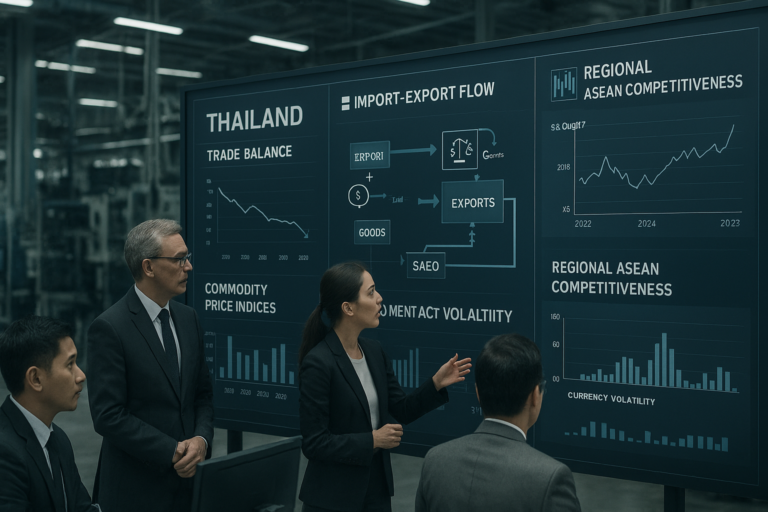
The key signal is the persistence of Thailand’s trade deficit amidst ongoing economic transformation, which underscores structural challenges in the country’s export composition and import reliance. This dynamic highlights growing pressure on trade balances driven by rising energy and commodity import costs alongside shifts in industrial production patterns. For investors, this signals a heightened sensitivity of Thailand’s economic performance to global commodity cycles and external demand fluctuations, with important ramifications for currency stability, corporate earnings, and capital allocation within export-dependent sectors.
Understanding Thailand trade deficit and economic transformation is essential for institutional investors and market participants as it directly affects the cost structures of manufacturing enterprises, influences foreign exchange volatility, and modulates investor sentiment. The underlying transformation in Thailand’s export profile, including the move toward higher value-added manufacturing and technology sectors, may initially exacerbate import requirements, reinforcing the current deficit trend. Consequently, this development signals evolving risk and return dynamics across key sectors, particularly energy, industrial manufacturing, and logistics, warranting informed reassessment of investment positioning in Thailand and the ASEAN region.
Key Facts
- Thailand is experiencing a sustained trade deficit phase related to increased import costs and weaker export growth.
- The trade deficit reflects structural shifts aligned with Thailand’s ongoing economic transformation toward more advanced manufacturing.
- Rising global commodity and energy prices have amplified import expenses.
- Export performance is affected by global demand cycles and competitive pressures within ASEAN.
Why It Matters
The sustained trade deficit signals underlying structural vulnerabilities rather than temporary cyclical imbalances. For the Thai economy, this indicates tension between the ambitions of upgrading industrial capacity and the accompanying reliance on imported inputs, particularly energy and intermediate goods. Such a dynamic affects the external sector’s resilience, impacting currency stability through increased demand for foreign exchange and heightening exposure to fluctuations in global commodity markets.
This matters because trade deficits over time can influence sovereign credit metrics and foreign reserve adequacy, which are critical for maintaining investor confidence in fixed income and currency markets. For Thailand, an import structure exposed to volatile energy prices creates a channel of macroeconomic risk that private sector actors—including exporters and importers—must manage carefully. Moreover, it impacts the competitive position of Thai firms vis-à-vis regional peers within ASEAN and broader supply chains, potentially affecting foreign direct investment flows linked to manufacturing exports.
Investment Implications
Investors should incorporate the trade deficit trend into risk assessments relating to foreign exchange exposures, corporate earnings volatility, and cost inflations for sectors reliant on imported raw materials. Export-oriented companies—particularly those in automotive, electronics, and machinery manufacturing—may experience margin pressure if input price inflation outpaces export price gains. This introduces greater scrutiny on firms’ operational efficiency, supply chain diversification, and hedging strategies.
The interaction between Thailand’s economic transformation and the trade deficit progression also introduces a nuanced capital allocation environment. Sectors supporting higher value-added exports might attract investment for growth prospects but necessitate balancing the risk of elevated import dependency. Additionally, market participants must evaluate impacts on banking sector asset quality and lending patterns, as cost pressures on corporate borrowers rise amid margin volatility.
Sector Impact
Positive
- Technology and Advanced Manufacturing: Growth prospects in higher value-added export sectors align with Thailand’s industrial upgrade goals, attracting capital despite import-related cost risks.
Neutral
- Logistics and Trade Services: Increased trade volume complexity sustains demand for logistics and related services, balancing import-export flows though margins may be affected by cost pressures.
Risk
- Energy and Commodities: The import reliance exposes these sectors and their downstream industrial consumers to commodity price volatility and supply chain shocks.
- Export Manufacturing: Margin compression risk due to rising input costs and competitive pressures from regional ASEAN producers with different cost structures.
Strategic Signals
This development indicates that Thailand’s economic transformation is generating a transitional phase characterized by structural trade imbalances, reflecting higher dependence on imported inputs within advanced manufacturing. It signals an evolving market structure where Thailand’s role in regional and global supply chains is shifting from low-cost assembly to more complex production requiring sophisticated inputs, many sourced externally.
The amplified trade deficit embodies second-order effects on Thailand’s currency and external financial stability, highlighting the importance of balancing economic modernization with sustainable external accounts. The development suggests that Thailand must strengthen resilience mechanisms—such as supply-chain diversification and energy transition strategies—to mitigate external vulnerabilities as it aspires to higher value-added economic roles.
ASEAN Context
This development appears primarily domestic in nature with limited immediate ASEAN-wide implications.
Risks
Execution risks stem from sustained trade deficits pressuring Thailand’s foreign exchange reserves and currency stability, which could elevate borrowing costs for corporates reliant on foreign currency-denominated debt. Exposure to volatile global commodity prices presents financial risks, affecting profit margins and investment returns in energy-intensive sectors. Market risks include potential investor repricing of growth and external balance risks, with impacts on foreign capital inflows.
The transformation process itself is a source of uncertainty; failure to effectively upgrade export capabilities or manage import dependencies could undermine competitiveness and investment sentiment. The complexity of global trade environments further exacerbates these risks for Thailand.
Bottom Line
The persistence of Thailand’s trade deficit amid economic transformation signals a structural evolution with important implications for investment risk and sector positioning. It highlights the need for investors to account for heightened sensitivity to commodity price cycles, import reliance, and export competitiveness in their valuation and capital allocation frameworks. Recognizing these dynamics is critical for assessing Thailand’s external resilience and the viability of growth prospects tied to upgraded manufacturing capabilities.
Thailand Investor Brief
Stay Ahead of Thailand and ASEAN Markets
Explore Thailand Signal Capital’s flagship investor intelligence service,
including free market insights and premium daily briefings for investors,
executives, entrepreneurs, and ASEAN-focused professionals.
- Thailand and ASEAN market intelligence
- Investment implications and strategic signals
- FREE and PRO briefing options
Frequently Asked Questions
Why does this development matter for Thailand investors?
This development matters because it may affect Thailand’s investment
environment through policy direction, sector exposure, trade dynamics,
capital allocation, or ASEAN market positioning.
Which sectors could be affected?
The most relevant sectors depend on the specific development, but investors
should assess exposure across policy-sensitive industries, financial
services, trade-linked sectors, infrastructure, property, tourism, energy,
and ASEAN-facing businesses.
How does this affect Thailand’s position in ASEAN?
The ASEAN impact depends on whether the development changes regional
competitiveness, cross-border investment, supply chains, or investor
sentiment. Thailand’s role should be assessed relative to nearby markets
such as Singapore, Malaysia, Vietnam, Indonesia, and Cambodia.
What should investors watch next?
Investors should watch implementation details, policy follow-through,
sector-level responses, corporate earnings signals, regulatory changes,
and whether the development creates measurable shifts in demand, costs,
or capital flows.
Complete Guide
For a broader investment framework, continue with the Thailand Tourism Investment Guide 2026.