Executive Summary
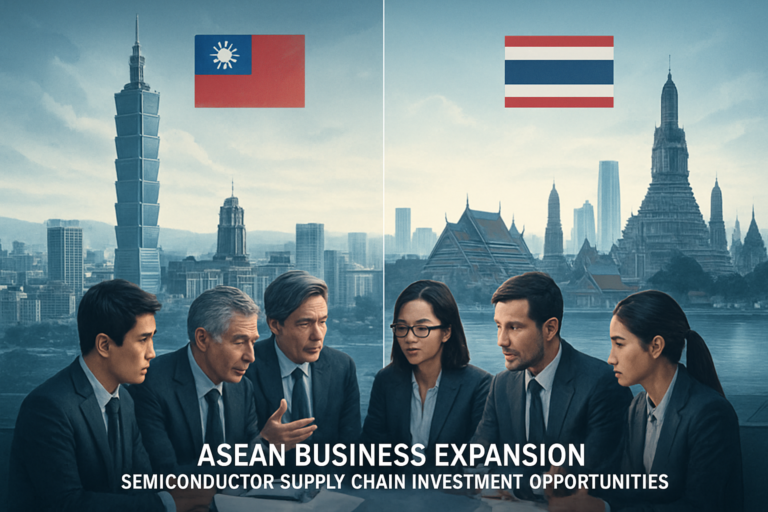
The strategic comparison of Thailand vs Taiwan semiconductor supply chain capabilities highlights contrasting strengths shaped by their industrial maturity, infrastructure, and geopolitical positioning. Taiwan remains globally dominant in advanced semiconductor manufacturing and chip design, benefiting from a deeply entrenched ecosystem that supports wafer fabrication, cutting-edge packaging, and cutting-edge R&D. Conversely, Thailand’s semiconductor supply chain is more focused on downstream processes such as assembly, testing, and electronics manufacturing, supported by evolving infrastructure and cost advantages within the ASEAN region.
From an investor perspective, Thailand appears better suited for businesses aiming to establish or expand regional chip packaging and assembly operations that leverage competitive manufacturing costs and ASEAN market access. Taiwan remains attractive for investors prioritizing advanced semiconductor manufacturing, innovation leadership, and access to cutting-edge technology. The trade-offs between Thailand’s emerging ecosystem and Taiwan’s industrial sophistication encompass operational scale, geopolitical risk exposure, and regulatory frameworks.
Investors evaluating the Thailand vs Taiwan semiconductor supply chain should carefully consider their strategic priorities regarding operational focus, production maturity, and geopolitical factors, while monitoring infrastructure developments and policy shifts that could impact long-term supply chain resilience and regional competitiveness.
Key Facts
- Economy: Taiwan has a high-income, industrialized economy with a strong focus on high-technology exports; Thailand is an upper-middle-income emerging market with a diversified industrial base.
- Regulation: Taiwan’s regulatory environment supports intellectual property protection and advanced manufacturing; Thailand’s regulatory reforms aim to enhance foreign investment but with more variable execution.
- Infrastructure: Taiwan offers established advanced manufacturing infrastructure, reliable power, and top-tier logistics; Thailand has growing industrial zones with improving connectivity but less specialization in advanced chip fabrication.
- Costs: Thailand generally offers lower labor and operational costs compared to Taiwan.
- Investment Climate: Taiwan benefits from an established semiconductor ecosystem; Thailand offers targeted incentives for electronics manufacturing and is promoting ASEAN integration.
- Market Access: Thailand provides preferential access and trade agreements within ASEAN; Taiwan’s access is more global but impacted by geopolitical tensions.
- Workforce: Taiwan has a highly skilled semiconductor labor pool focused on advanced manufacturing; Thailand’s workforce has strengths in assembly and electronics manufacturing but requires ongoing skills development for higher technology levels.
- Foreign Ownership: Taiwan has tighter foreign ownership restrictions reflective of strategic industry controls; Thailand permits foreign investment with sector-specific approvals.
Comparison Analysis
The Thailand vs Taiwan semiconductor supply chain comparison reveals clear differentiation in industrial maturity and ecosystem depth. Taiwan’s semiconductor industry embodies vertical integration from design to advanced wafer fabrication and packaging, supported by long-standing clusters and R&D capabilities. Thailand serves as a logistics and assembly hub within ASEAN’s electronics manufacturing scene, with growing ambitions to capture more sophisticated chip packaging and testing activities.
Operational costs, infrastructure sophistication, skilled labor availability, and geopolitical dynamics drive key investor considerations between these markets. Taiwan’s semiconductor industry commands premium valuations tied to advanced technology leadership and global market reach. Thailand’s growing ASEAN-oriented supply chains provide cost-effective alternatives with potentially lower geopolitical exposure and benefit from regional supply chain diversification strategies.
| Criteria | Thailand | Taiwan |
|---|---|---|
| Economy | Upper-middle income, diversified manufacturing | High income, advanced tech manufacturing |
| Market Size | ASEAN focused, growing domestic demand | Global export-driven semiconductor industry |
| Infrastructure | Developing advanced manufacturing zones | Established, specialized semiconductor fabs and logistics |
| Taxation | Incentives for electronics, variable enforcement | Incentives for R&D and manufacturing innovation |
| Regulation | Improving, with more variable execution | Established with strong IP protection |
| Logistics | Competitive ASEAN logistics hub | Global semiconductor supply chain node |
| Labour | Lower cost but developing skills | Highly skilled semiconductor workforce |
| Competitiveness | Cost competitiveness in assembly and testing | Global leader in semiconductor manufacturing |
| Investment Incentives | Targeted incentives for electronics manufacturing | Strong incentives supporting advanced R&D |
| Supply Chains | Part of ASEAN electronics clusters, integration growing | Highly integrated global semiconductor supply chains |
| Political Stability | Moderate political risk | Geopolitical tensions with China |
| ESG Readiness | Emerging with focus on environmental compliance | Advanced ESG practices in leading manufacturers |
| Skilled Labour | Growing with government support | Highly developed semiconductor engineering talent pool |
| Industrial Clusters | Emerging electronics manufacturing clusters | Mature semiconductor industrial ecosystems |
The comparison suggests investors seeking advanced wafer fabrication and design should lean towards Taiwan for its unparalleled infrastructure and ecosystem. Thailand’s strengths lie in scaled assembly, testing, and packaging activities tethered to ASEAN’s economic integration and cost structures. Thailand’s positioning benefits investors emphasizing regional diversification and lower operational expenses.
The structural advantages supporting Thailand’s semiconductor supply chain expansion include access to ASEAN markets, supportive financial incentives for electronics manufacturing, and labor cost competitiveness. Taiwan’s industrial sophistication with R&D leadership and high-end wafer fabrication keeps it central to global semiconductor innovation and product complexity.
Capital allocation decisions must weigh geopolitical risks; Taiwan faces considerable uncertainty tied to cross-strait relations, whereas Thailand faces more domestic political variability but lower direct international risk. Both countries’ supply chains are evolving in response to global pressures underscoring supply chain resilience and diversification.
Long-term, Thailand’s semiconductor supply chain development is linked to ASEAN’s integration trajectory and industrial upgrading initiatives, while Taiwan’s global semiconductor leadership sustains a unique, more advanced positioning despite geopolitical headwinds.
Decision Framework
Investors prioritizing infrastructure excellence, sophisticated manufacturing capabilities, and advanced R&D ecosystems will find Taiwan better suited to their needs. Taiwan’s vertically integrated semiconductor industry enables cutting-edge wafer fabrication and complex chip packaging unmatched by Thailand’s current ecosystem.
In contrast, investors focused on cost efficiency, speed to market within ASEAN, and leveraging a growing regional electronics manufacturing hub may prefer Thailand. Thailand offers a competitive labor cost environment and benefits from trade agreements within ASEAN favoring regional supply chain expansion, especially in chip packaging and assembly segments.
Thailand aligns with investor profiles aiming to establish or scale semiconductor packaging/testing facilities or electronics manufacturing plants with regional market aspirations. Taiwan fits investors focused on advanced semiconductor manufacturing, design innovation, and global export-driven supply chains.
Future shifts in the regulatory framework, infrastructure investments, or geopolitical stabilisation could alter these preferences. For instance, significant investments enhancing Thailand’s advanced manufacturing capabilities or shifts reducing Taiwan’s geopolitical risks would modify the balance of attractiveness.
Investment Implications
Investors seeking exposure in the ASEAN chip supply chains, particularly in assembly, packaging, and downstream manufacturing, benefit from Thailand’s improving infrastructure and cost environment. Thailand’s growing integration into regional electronics clusters enhances its attractiveness for expanding capacity within ASEAN’s economic framework.
Conversely, investors focused on the Taiwan semiconductor industry’s advanced manufacturing and R&D leadership can capitalize on its mature ecosystem’s high barriers to entry and innovation-driven growth. Taiwan remains a strategic base for companies concentrating on leading-edge wafer fabs and sophisticated chip design.
Capital allocations should consider operational scale, supply chain diversification, and geopolitical risk management. Manufacturing relocation or expansion aimed at mitigating global supply chain bottlenecks might favour Thailand if prioritizing cost and ASEAN exposure. For high-end technology development and global market reach, Taiwan still commands a premium position.
Long-term positioning relies on monitoring regional policy developments such as ASEAN integration, government industrial strategies, and geopolitical tensions affecting supply chain security. Portfolio diversification across both markets may optimize risk-return profiles given complementary industry strengths.
Sector Impact
Manufacturing
Thailand’s semiconductor manufacturing is largely weighted towards packaging, testing, and electronics assembly, representing an important node in ASEAN’s electronics manufacturing network. Taiwan’s manufacturing sector is widely recognized for advanced wafer fabrication and design, maintaining global technology leadership in semiconductor production.
Logistics
Thailand functions as a regional logistics hub within ASEAN, supported by developing industrial zones optimized for electronics throughput. Taiwan serves as a critical global semiconductor logistics node, linking advanced manufacturing output to international markets with efficient supply chain networks.
Strategic Signals
Structural trends underpin Thailand’s focus on upgrading chip packaging and testing capabilities as part of broader efforts to establish scaled ASEAN chip supply chains. Government incentives and investments in industrial infrastructure signal continued support for electronics manufacturing expansion. In Taiwan, strategic policy maintains leadership in semiconductor R&D and advanced manufacturing despite growing geopolitical pressures. Investment signals prioritize resilience and technological innovation.
ASEAN Context
Thailand’s semiconductor supply chain is increasingly interwoven with ASEAN economic integration initiatives, benefiting from preferential trade agreements and emerging industrial clusters. Cross-border investment within ASEAN facilitates component sourcing and assembly economies of scale. Taiwan, while external to ASEAN, influences regional supply chains through partnerships and technology transfer, creating complementary dynamics amid regional competition.
Risks
Regulatory risk in Thailand remains moderate due to ongoing reforms and variable enforcement, potentially impacting execution speed. Taiwan faces higher geopolitical risk stemming from cross-strait tensions that could disrupt global supply chains. Currency volatility and macroeconomic shifts in both markets require prudent risk management.
ESG considerations are evolving, with Taiwan’s semiconductor firms generally more advanced in environmental compliance than Thailand’s emerging efforts. Execution risks include infrastructure gaps in Thailand and capacity constraints in Taiwan. Macro risks such as global semiconductor demand fluctuations also weigh on investment attractiveness.
Decision Scorecard
| Criteria | Thailand | Taiwan |
|---|---|---|
| Infrastructure Readiness | Developing | Strong |
| Labour Cost Advantage | Strong | Moderate |
| Skilled Labour Availability | Developing | Strong |
| Logistics Efficiency | Moderate | Strong |
| Investment Incentives | Moderate | Strong |
| Regulatory Predictability | Developing | Strong |
| Supply Chain Depth | Developing | Strong |
| Long-Term Strategic Fit | Moderate | Strong |
Thailand is best suited for investors emphasizing cost efficiency, regional ASEAN market access, and scalable assembly and testing operations within emerging supply chains. The environment encourages incremental growth aligned with ASEAN industrial policies.
Taiwan suits investors requiring advanced manufacturing ecosystems, superior skilled labor, and global semiconductor integration despite geopolitical exposures. It remains a premier location for innovation-centric investment in chips.
Bottom Line
Thailand fits investors targeting cost-effective semiconductor packaging, assembly, and testing within a growing ASEAN regional supply chain, especially those seeking to diversify operations away from geopolitical hotspots while leveraging emerging industrial clusters.
Investors aiming at advanced wafer fabrication, chip design innovation, and leadership in the semiconductor value chain may prioritize Taiwan, despite potential geopolitical tensions and higher operational costs, due to its mature ecosystem and technological advantages.
Institutional investors should monitor developments in infrastructure upgrades, regulatory reforms, geopolitical risks, and regional integration policies before allocating capital to either market. Balancing these trade-offs is critical for long-term semiconductor supply chain resilience and investment returns.
Thailand Investor Brief
Stay Ahead of Thailand and ASEAN Markets
Explore Thailand Signal Capital’s flagship investor intelligence service,
including free market insights and premium daily briefings for investors,
executives, entrepreneurs, and ASEAN-focused professionals.
- Thailand and ASEAN investment intelligence
- Decision-oriented market and policy analysis
- FREE and PRO briefing options
Related Thailand Investment Intelligence
- Thailand Automotive Exports Signal Growth in Hyundai BEV Supply Chain for Australia
- Best ASEAN Country for Manufacturing Investment: Infrastructure and Supply Chain Comparison
- Thailand EV Manufacturing Supply Chains: Strategic Policy Signals and Investment Implications
- ASEAN Macroeconomic Policy Shift Signals Key Investment Considerations for Thailand
Frequently Asked Questions
Is Thailand a better investment destination than Taiwan?
Thailand may be more attractive for some investors, while Taiwan may offer advantages for others. The right choice depends on sector, risk tolerance, cost structure, market access needs, regulatory exposure, and long-term ASEAN strategy.
What are the main differences between Thailand and Taiwan for investors?
The main differences usually involve policy direction, operating costs, infrastructure depth, workforce availability, sector maturity, foreign ownership rules, supply chain positioning, and exposure to regional demand.
Which sectors are most relevant in this comparison?
The most relevant sectors depend on the topic, but common areas include Property, Energy, Tourism, Banking, Fintech, Infrastructure, Logistics, Exports, Manufacturing, and ASEAN Supply Chains.
How should foreign investors use this comparison?
Foreign investors should use this comparison to identify where Thailand has structural advantages and where another market may offer better conditions. The most important factors are regulatory stability, execution risk, market access, cost competitiveness, and long-term economic direction.
What should investors watch next?
Investors should monitor policy implementation, foreign investment rules, sector incentives, currency conditions, infrastructure development, corporate earnings signals, demand trends, and regional competition.
Complete Guide
For a broader investment framework, continue with the Thailand ASEAN Investment Guide 2026.