Executive Summary
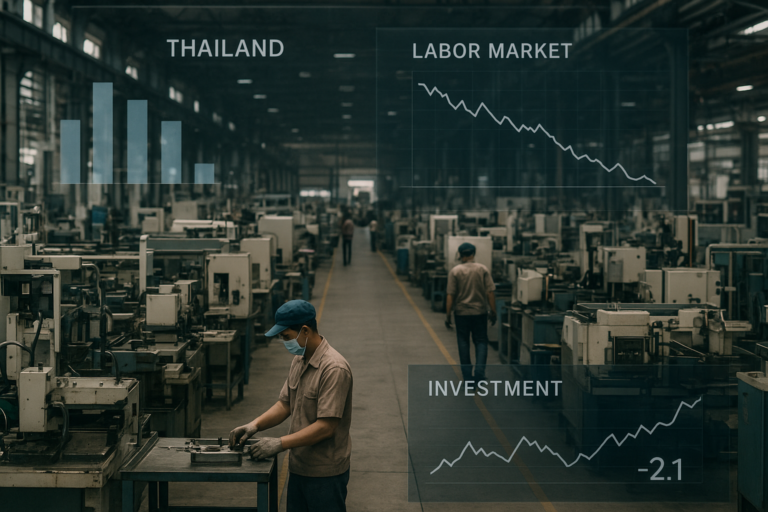
The key signal is Thailand’s labor market fragility, which underscores structural vulnerabilities affecting workforce stability and productivity. This state of fragility introduces important considerations for investors regarding economic resilience, sectoral performance, and capital allocation within Thailand’s evolving landscape. Understanding these labor market dynamics is crucial for international and institutional investors seeking to evaluate Thailand’s economic fundamentals amid regional competition.
Labor market fragility matters because it negatively influences consumer confidence, disrupts production continuity, and raises operational costs. For Thailand, a country reliant on labor-intensive industries such as manufacturing and tourism, persistent labor weaknesses could constrain growth and profitability. These dynamics demand a recalibration of risk assessments by market participants, particularly in sectors sensitive to workforce disruptions.
Moreover, Thailand’s labor vulnerabilities may alter its comparative advantage within ASEAN, potentially shifting investor interest toward more stable regional alternatives. Recognizing Thailand labor market fragility thus provides critical insight for strategic investment decisions and sector positioning in Southeast Asia.
Key Facts
- Thailand’s labor market exhibits fragility characterized by workforce instability and gaps in labor supply-demand matching.
- Labor market weakness affects key sectors, notably labor-intensive manufacturing and tourism services.
- The labor situation has broader economic consequences, including reduced consumer spending power and potential shifts in production dynamics.
- Structural issues within the labor market persist despite macroeconomic growth, illustrating underlying workforce challenges.
Why It Matters
Labor market fragility in Thailand signals constraints on the country’s economic resilience and competitiveness. Weak labor dynamics reduce productivity and disrupt supply chains, particularly in manufacturing hubs where workforce reliability is critical. This fragility suppresses household income growth, directly impacting consumption patterns and dampening retail and domestic service sectors.
For investors, these conditions imply elevated risk profiles for Thailand’s labor-intensive sectors, potentially leading to greater operational costs and delayed project timelines. On a macroeconomic level, workforce instability complicates fiscal planning and pressures policies aimed at sustaining domestic demand and export performance. Disruptions in the labor market also raise the risk of increased wage pressures amid shortages, influencing corporate expense structures.
Investment Implications
Thailand labor market fragility affects capital deployment strategies by heightening uncertainty in workforce-dependent sectors. Investors engaged in manufacturing, hospitality, and retail may face margin compression driven by labor turnover and recruitment challenges. Additionally, companies reliant on consistent labor availability might reassess expansion or scaling timelines to mitigate labor-related risks.
Financial valuations in sectors with high labor intensity could integrate these risks, potentially affecting market multiples and borrowing costs. Furthermore, fragile labor conditions might prompt corporate strategies to intensify automation or offshore labor-intensive functions, impacting sectors differently based on their adaptability to labor constraints.
From a business executive perspective, labor instability necessitates strengthening workforce planning, improving labor relations, and exploring productivity enhancements to sustain competitiveness. Institutional investors should factor labor market conditions into sector risk assessments and portfolio diversification approaches within Thailand and the broader ASEAN region.
Sector Impact
Positive
- Technology and Automation: Rising labor market fragility incentivizes adoption of automation and technology solutions, benefiting companies in this space.
Neutral
- Financial Services: Limited direct impact as labor market fragility primarily affects industrial and service sectors more intensely.
Risk
- Manufacturing: High exposure to labor shortages and turnover can disrupt production schedules and increase costs.
- Tourism and Hospitality: Vulnerable to workforce instability impacting service quality and operational efficiency.
- Retail and Domestic Services: Subject to fluctuations in consumer spending tied to household income affected by labor fragility.
Strategic Signals
This labor market fragility highlights structural challenges in Thailand’s economic model reliant on labor-intensive growth. It signals potential pressures on Thailand’s ability to maintain a competitive cost advantage in ASEAN as human capital constraints emerge. The condition may accelerate strategic shifts toward technology adoption and productivity gains, realigning Thailand’s economic structure.
Additionally, fragile labor dynamics influence investor confidence, capital flow sustainability, and public-private efforts toward workforce development. It also signals the necessity for businesses and policymakers to integrate labor market considerations deeply into economic planning to safeguard Thailand’s regional positioning.
ASEAN Context
This development appears primarily domestic in nature with limited immediate ASEAN-wide implications.
Risks
Key risks include the persistence or worsening of labor shortages disrupting production and service delivery in critical sectors. Labor instability raises wage inflation risk, increasing costs for firms and pressuring profit margins. Furthermore, inadequate labor market responses could slow investment flows due to heightened operational uncertainties. There is also risk that labor market fragility hampers recovery of domestic consumption, prolonging economic headwinds.
Bottom Line
Thailand labor market fragility underscores structural labor constraints with tangible implications for productivity and economic stability. This development recalibrates sector risks, particularly in labor-dependent industries, and informs investment horizons and capital allocation decisions. Recognizing this fragility is essential for understanding Thailand’s evolving economic landscape and competitive positioning within ASEAN.
Thailand Investor Brief
Stay Ahead of Thailand and ASEAN Markets
Explore Thailand Signal Capital’s flagship investor intelligence service,
including free market insights and premium daily briefings for investors,
executives, entrepreneurs, and ASEAN-focused professionals.
- Thailand and ASEAN market intelligence
- Investment implications and strategic signals
- FREE and PRO briefing options
Frequently Asked Questions
Why does this development matter for Thailand investors?
This development matters because it may affect Thailand’s investment
environment through policy direction, sector exposure, trade dynamics,
capital allocation, or ASEAN market positioning.
Which sectors could be affected?
The most relevant sectors depend on the specific development, but investors
should assess exposure across policy-sensitive industries, financial
services, trade-linked sectors, infrastructure, property, tourism, energy,
and ASEAN-facing businesses.
How does this affect Thailand’s position in ASEAN?
The ASEAN impact depends on whether the development changes regional
competitiveness, cross-border investment, supply chains, or investor
sentiment. Thailand’s role should be assessed relative to nearby markets
such as Singapore, Malaysia, Vietnam, Indonesia, and Cambodia.
What should investors watch next?
Investors should watch implementation details, policy follow-through,
sector-level responses, corporate earnings signals, regulatory changes,
and whether the development creates measurable shifts in demand, costs,
or capital flows.
Complete Guide
For a broader investment framework, continue with the Thailand Tourism Investment Guide 2026.