Executive Summary
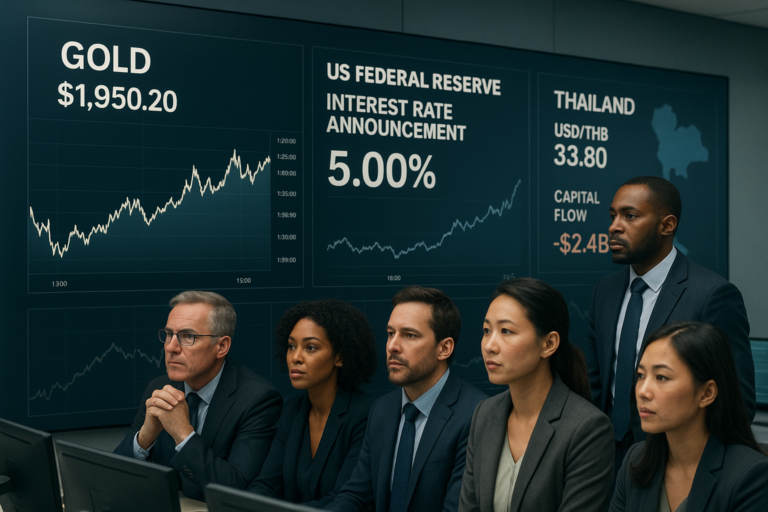
The key signal is that gold price volatility driven by fears of further US interest rate hikes reflects rising uncertainty in global monetary policy, which impacts Thailand through capital flow volatility and currency pressure. This heightened uncertainty interferes with smaller emerging markets’ financial stability, including Thailand’s, by influencing investor risk appetite and cost of capital. Understanding this dynamic is critical for investors and businesses exposed to foreign exchange risks and borrowing costs amid a shifting global interest rate environment.
Key Facts
- Gold prices have experienced notable fluctuations amid persistent concerns about potential US interest rate hikes.
- Investor sentiment is increasingly sensitive to Federal Reserve policy signals, affecting safe-haven asset demand.
- This price movement highlights uncertainty about the pace and magnitude of US monetary tightening.
Why It Matters
These gold price movements serve as a proxy for broader uncertainty influencing global risk assets and capital flows. For Thailand, this matters because volatility in US interest rates directly affects foreign investment flows and the Thai baht exchange rate. Fears of tightening in the US system tend to strengthen the dollar, placing depreciation pressures on the baht, which is detrimental for Thai importers and energy import bills, raising inflationary pressures domestically.
Moreover, higher global interest rates increase borrowing costs for Thailand’s sovereign and corporate debt issuers raised in foreign currency, constraining capital expenditure and project financing. The volatility in gold prices signals market nervousness that spreads beyond the metal, indicating reduced risk tolerance that may lead to outflows from emerging market equities and bonds, including Thailand’s financial markets.
For investors, this means heightened market risk and a less predictable environment for Thai assets denominated in baht or foreign currency. The sensitivity to US monetary policy developments increases volatility in capital markets and currency rates, impacting returns and financing conditions. Businesses dependent on export competitiveness could face challenges if baht depreciation intensifies input costs or if capital becomes more expensive.
Sector Impact
Positive:
- Gold-related sectors – Increased gold price volatility can boost gold trading and investing activities, benefiting financial services tied to precious metals.
Neutral:
- Tourism – While currency volatility affects foreign traveler spending power, tourism demand tends to be less directly tied to short-term gold price movements.
Risk:
- Financials – Banks and non-bank lenders may face increased credit risk and pressure on margins from currency and interest rate volatility.
- Exporters – Currency pressure from a stronger US dollar may erode export competitiveness if baht weakness increases inflation on imported inputs or disrupts cross-border contracts.
- Energy – Higher borrowing costs and a weaker baht raise the cost of importing energy, impacting industrial and consumer sectors.
ASEAN Context
This development appears primarily domestic in nature with limited immediate ASEAN-wide implications. However, the shared external exposure of ASEAN emerging markets to US interest rate uncertainty means Thailand’s financial conditions and capital markets are broadly reflective of regional risk dynamics. Countries with similar trade and financial linkages to the US dollar environment will face comparable currency and capital flow volatility.
Bottom Line
Gold price volatility amid US rate hike uncertainty signals a fragile investor risk sentiment environment impacting Thailand’s financial markets, currency, and borrowing costs. This dynamic underscores the sensitivity of Thailand’s economy to external monetary policy shifts, suggesting elevated risks for foreign capital flows and domestic financial stability. Investors and businesses exposed to currency fluctuations and external financing conditions should factor this heightened volatility into their risk assessments and strategic planning.
Thailand Investor Brief
Want deeper Thailand & ASEAN investor intelligence?
Join Thailand Investor Brief FREE
Unlock Thailand Investor Brief PRO
Complete Guide
For a broader investment framework, continue with the Thailand Tourism Investment Guide 2026.