Executive Summary
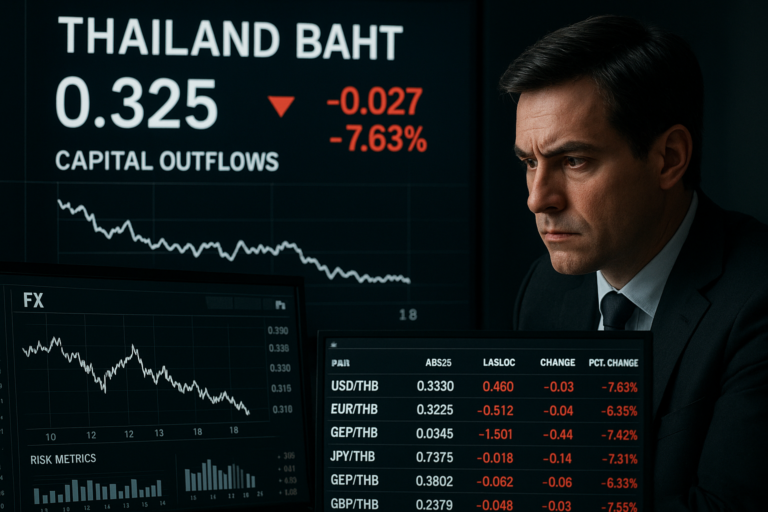
The key signal is that the recent depreciation of the Thai baht against foreign currencies, accompanied by capital outflows, reflects investor concerns about Thailand’s risk profile and liquidity conditions in FX markets. This development signals increased external pressure on Thailand’s currency stability and marks a shift in cross-border investor sentiment, which matters significantly for cost of capital, foreign holdings of Thai assets, and competitiveness of Thailand’s export sector.
Key Facts
- The Thai baht has weakened notably amid episodes of capital flight.
- Capital outflows indicate a reversal or slowdown of foreign investment inflows into Thailand.
- Market liquidity conditions in FX markets are tighter, with increased volatility in the baht’s exchange rate.
Why It Matters
The depreciation of the baht signals a re-pricing of Thailand’s risk premium among global and regional investors. A weaker baht raises the cost of servicing foreign-denominated debt for Thai corporates and financial institutions, increasing credit risk in the banking sector. For exporters, a depreciated baht can enhance competitiveness by improving the local currency value of foreign sales, potentially supporting earnings and trade balances. However, the capital flight associated with baht weakness heightens funding and liquidity risks, threatening to constrain credit availability and raise borrowing costs domestically.
This FX volatility also reflects a reassessment of Thailand’s macro-financial stability, possibly driven by geopolitical uncertainties, monetary policy divergences, or shifts in investor risk appetite. The capital outflows reduce the pool of foreign liquidity supporting domestic markets and may prompt policy or market interventions to stabilize the currency. For foreign investors, the baht depreciation and capital flight imply a deterioration in risk-adjusted returns, influencing future investment allocation decisions.
Sector Impact
Positive:
- Exporters – Benefit from improved export competitiveness due to a cheaper baht, potentially boosting revenues in USD terms.
Neutral:
- Tourism – While FX depreciation can attract price-sensitive tourists, the impact may be muted if capital outflows undermine broader economic confidence.
Risk:
- Financial Sector – Heightened credit risk from currency mismatches and increased foreign borrowing costs.
- Importers and Energy-Intensive Industries – Face higher costs as energy and raw material imports become more expensive in baht terms.
- Domestic Corporates with FX Debt – Increased debt servicing burden due to baht depreciation raises default risk.
ASEAN Context
The development is emblematic of broader regional capital flow volatility, amid global monetary tightening and geopolitical tensions, affecting ASEAN currencies variably. Thailand’s experience underscores regional vulnerabilities to sudden stops and shifts in external investor sentiment. However, this capital flight and baht depreciation appear primarily domestic in nature with limited immediate ASEAN-wide implications, contingent on Thailand-specific factors such as foreign portfolio weight and macroeconomic fundamentals.
Bottom Line
Thailand’s baht depreciation amid capital flight signals elevated external pressures that raise cost of capital and financial risks for domestic corporates and banks. Exporters stand to gain short-term competitiveness, but the broader impact includes higher funding costs and potential volatility in credit conditions. Investors should price in increased FX risk premiums and reassess exposure to baht-denominated assets amid market liquidity constraints and shifting capital flows.
Stay Ahead of Thailand and ASEAN Markets
Thailand Investor Brief delivers AI-powered investor intelligence covering Thailand’s economy, markets, policy developments, and ASEAN business trends.
Receive daily insights designed for investors, executives, entrepreneurs, and globally minded professionals.
Join thousands of readers following the signals that matter across Thailand and ASEAN.
Join Thailand Investor Brief FREE
Complete Guide
For a broader investment framework, continue with the Thailand Tourism Investment Guide 2026.