Executive Summary
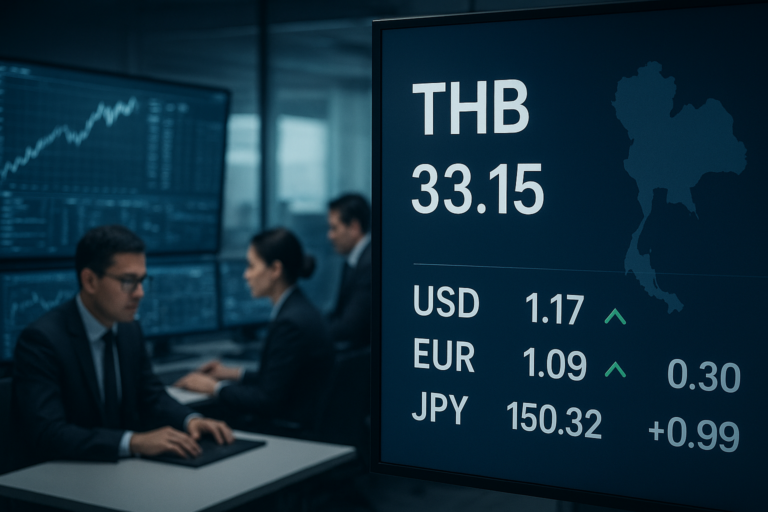
The key signal is the Thai baht’s sustained stability amid a turbulent global foreign exchange environment, indicating resilient investor confidence in Thailand’s macroeconomic fundamentals and external balances. This matters because the baht’s steadiness supports predictable import costs, preserves purchasing power for energy-dependent sectors, and stabilizes capital flows that are crucial for maintaining Thailand’s financial market health.
Key Facts
- The Thai baht has exhibited relative stability against major currencies during recent FX market volatility.
- Foreign investor flows into Thai capital markets have remained steady despite global risk-off episodes.
- The external balances, including current account surpluses and foreign reserves, provide a buffer supporting the baht’s stability.
Why It Matters
Foreign exchange stability is a decisive factor for Thailand’s investor environment and broader economic outlook. The baht’s resilience signals continued trust in Thailand’s economic policy framework and external fundamentals despite external shocks. For investors, a stable baht reduces currency-related earnings volatility for companies with foreign currency exposures, thus enhancing valuation reliability for listed exporters and importers.
Moreover, energy imports priced in US dollars constitute a significant cost for Thailand’s economy. A stable baht mitigates inflationary pressures stemming from volatile exchange rates, helping contain input cost inflation in manufacturing and transportation sectors. This dynamic favors both corporate margins and consumer price stability, preserving domestic purchasing power.
From an investment flows perspective, currency stability lowers hedging costs and FX risk premiums, encouraging sustained inflows into Thai equity and bond markets. This contributes to favorable liquidity conditions and borrowing costs for Thai corporates, supporting capital raising and expansion initiatives.
Sector Impact
Positive:
- Exporters – currency stability preserves competitiveness and revenue predictability in foreign markets.
- Energy-dependent industries – stable import costs reduce input price volatility, aiding margin management.
- Financial markets – steadier FX reduces hedging costs and supports sustained foreign capital inflows.
Neutral:
- Domestic consumption sectors – while indirectly benefiting from price stability, less directly impacted by FX changes.
Risk:
- Currency traders and speculators – reduced volatility limits short-term trading opportunities.
ASEAN Context
This development appears primarily domestic in nature with limited immediate ASEAN-wide implications. However, Thailand’s currency stability relative to some regional peers under FX pressure may enhance its attractiveness as a regional investment destination, impacting intra-ASEAN capital allocation patterns marginally.
Bottom Line
The Thai baht’s stability signals robust underlying macro fundamentals, which in turn supports investor confidence and reduces currency risk premiums. This condition benefits exporters, energy-importing sectors, and capital markets by containing cost and earnings volatility. For investors, the environment fosters predictable returns and consistent capital inflows, making Thai assets more appealing in an uncertain global FX backdrop.
Stay Ahead of Thailand and ASEAN Markets
Thailand Investor Brief delivers AI-powered investor intelligence covering Thailand’s economy, markets, policy developments, and ASEAN business trends.
Receive daily insights designed for investors, executives, entrepreneurs, and globally minded professionals.
Join thousands of readers following the signals that matter across Thailand and ASEAN.
Join Thailand Investor Brief FREE
Complete Guide
For a broader investment framework, continue with the Thailand Energy Investment Guide 2026.