Executive Summary
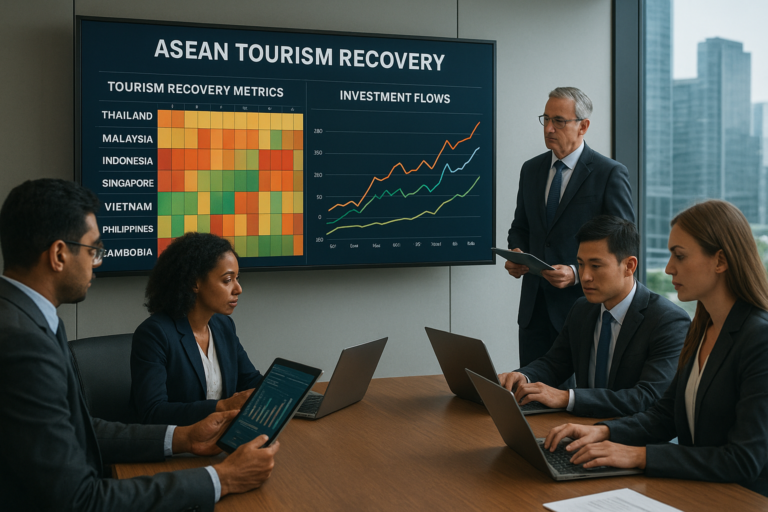
The key signal is how the evolving tourism outlook directly influences Thailand’s investment landscape relative to regional peers, shaping capital allocation and sector prospects. This development signals a recalibration of Thailand’s attractiveness for foreign investors, particularly in tourism-dependent sectors amid changing market dynamics. Understanding Thailand investment comparisons and tourism outlook highlights the nuanced trade-offs investors face between short-term disruptions and long-term structural opportunities.
This matters for investors, executives, and entrepreneurs considering Thailand exposure as it nuances the sectoral growth potential and risk profiles. Thailand’s tourism recovery trajectory juxtaposed with comparative investment conditions in ASEAN reveals shifting patterns in capital flows, consumer spending, and industry resilience. Such insights are essential for precise risk management and strategic positioning within Thailand’s tourism, property, and ancillary service sectors.
Key Facts
- Thailand is undergoing changes in its tourism sector with mixed signals on recovery pace and capacity utilization.
- Relative to ASEAN peers, Thailand’s investment environment is affected by its tourism sector performance and related infrastructure readiness.
- The tourism outlook influences broader economic activity patterns, particularly domestic consumption and service exports.
Why It Matters
The tourism sector’s oscillating recovery impacts Thailand’s overall investment environment by altering demand trajectories within hospitality, retail, and transportation sectors. Given tourism’s sizable contribution to service exports and domestic GDP, a slower or uneven recovery shifts earnings expectations and cash flow stability for multiple listed companies and SMEs. This creates bifurcated performance within sectors exposed to discretionary spending, with implications for credit risk and equity valuations.
Investment comparisons across ASEAN demonstrate that Thailand’s tourism outlook is a material variable influencing its relative competitive position. Investors contrast Thailand’s infrastructure bottlenecks and policy responses with competitor markets, impacting capital allocation decisions. Understanding these dynamics allows investors to distinguish between structural advantages versus cyclical vulnerabilities within Thailand’s investment opportunities.
Investment Implications
Capital allocation decisions will increasingly reflect sector-specific sensitivities to tourism demand. Tourism-dependent real estate, hospitality, and retail portfolios will face higher risk premiums until demand stabilizes. Conversely, sectors less reliant on tourism may gain investor favor, shifting the profile of growth opportunities within Thailand.
Moreover, foreign investor confidence hinges on clear visibility of the tourism sector’s path to normalization and corresponding policy frameworks. Uncertainties in tourism recovery timelines translate into volatility in investment inflows and currency stability, influencing borrowing costs and financing conditions for Thai entities.
Operationally, executives must incorporate fluctuating tourist arrivals into revenue forecasts and cost management strategies, particularly in labor-intensive services and supply chains serving inbound visitors. This affects cash flow projections and investment pacing, relevant for public and private companies alike.
Sector Impact
Positive
- Tourism and Hospitality: Gradual recovery prospects support selective revenue stabilization and margin improvement for key players engaged in accommodation, food services, and tourism infrastructure.
Neutral
- Financial Services: Impact is indirect; financial institutions with broad exposure to tourism-linked sectors will experience mixed effects based on portfolio composition.
- Manufacturing and Exporters: Limited direct impact as demand drivers are more external and commodity-resource oriented.
Risk
- Commercial Real Estate: Office and retail spaces with tourism linkage may face occupancy and rental rate pressure from uneven demand recovery.
- Consumer Discretionary: Companies dependent on tourist-driven consumption could face revenue volatility and profit margin compression.
Strategic Signals
This development signals a reassessment in Thailand’s role within global and regional tourism supply chains and investment appeal. It reflects structural challenges in infrastructure capacity and service quality relative to ASEAN competitors, indicating that market participants are recalibrating expectations for sectoral growth and risk premiums. The signal underscores the necessity for Thailand to align investment promotion with tourism sector enhancements to sustain long-term capital flow and economic diversification.
Second-order effects suggest shifts in domestic consumption patterns and labor market dynamics within tourism hubs, reinforcing a focus on targeted policy and business innovation to enhance resilience. The Thailand investment comparisons and tourism outlook dynamic highlights the balancing act between recovering inbound flows and evolving investor confidence, shaping Thailand’s investment narrative.
ASEAN Context
This development appears primarily domestic in nature with limited immediate ASEAN-wide implications.
Risks
Execution risks center on the pace and consistency of tourism sector recovery, where delays may prolong sectoral revenue volatility and investor uncertainty. Market risks include potential shifts in global travel patterns that could disadvantage Thailand relative to competing ASEAN destinations, affecting capital inflows and foreign exchange stability.
Policy risks manifest in the alignment of regulatory and infrastructure support needed to sustain tourism growth; gaps here could erode Thailand’s competitive positioning and investment attractiveness. Financial risks for companies with concentrated exposure to tourism revenues include cash flow stress and increased borrowing costs due to fluctuating demand.
Bottom Line
The primary takeaway is that Thailand’s investment appeal is increasingly contingent on the trajectory of its tourism sector recovery, which acts as a barometer for sectoral risk and opportunity. Investment comparisons within ASEAN emphasize the need for precision in evaluating sector exposures tied to tourism dynamics. Thailand’s ability to reconcile tourism resurgence with infrastructure and policy support will critically influence investor confidence and capital flow patterns going forward.
Complete Guide
For a broader investment framework, continue with the Thailand Macro Investment Guide 2026.
Thailand Investor Brief PRO
Want deeper institutional-grade Thailand market intelligence?
Thailand Investor Brief PRO delivers three daily briefings with strategic market analysis, investment implications, and ASEAN intelligence beyond the public news cycle.
Related Thailand Investment Intelligence
- Thailand vs India for Pharmaceutical Manufacturing: An Institutional Investment Comparison
- Thailand EU Free Trade Agreement: Strategic Implications for Investors
- Thailand Domestic Tourism Outlook 2026: Investment Implications and Sector Analysis
- Thailand Domestic Tourism Outlook 2026: Investment Implications
- Thailand vs Laos for Railway Investment: Strategic Insights for ASEAN Infrastructure Investors
Frequently Asked Questions
Why does this development matter for Thailand investors?
This development matters because it may affect Thailand’s investment environment through policy direction, sector exposure, trade dynamics, capital allocation, or ASEAN market positioning.
Which sectors could be affected?
The most relevant sectors depend on the specific development, but investors should assess exposure across policy-sensitive industries, financial services, trade-linked sectors, infrastructure, property, tourism, energy, and ASEAN-facing businesses.
How does this affect Thailand’s position in ASEAN?
The ASEAN impact depends on whether the development changes regional competitiveness, cross-border investment, supply chains, or investor sentiment. Thailand’s role should be assessed relative to nearby markets such as Singapore, Malaysia, Vietnam, Indonesia, and Cambodia.
What should investors watch next?
Investors should watch implementation details, policy follow-through, sector-level responses, corporate earnings signals, regulatory changes, and whether the development creates measurable shifts in demand, costs, or capital flows.