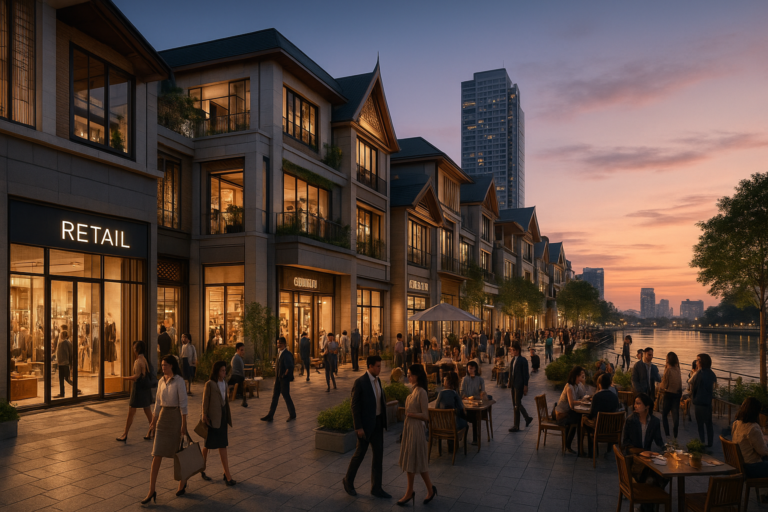
Executive Summary
The key signal is that AWC’s redevelopment of Asiatique marks a strategic shift toward integrated mixed-use property projects that mesh retail, tourism, and urban lifestyle in prime Bangkok locations. This move reflects evolving investor and consumer preferences in Thailand’s property sector and signals increased competition for market share within experiential retail and lifestyle real estate. For investors, understanding this repositioning is critical as it highlights Thailand’s ongoing transformation of legacy assets to capture higher value, intensify visitor engagement, and diversify revenue streams.
This development matters because it underscores the resilience and adaptability of Thailand’s real estate market to changing consumption patterns amid shifting tourism dynamics. The AWC Asiatique redevelopment emerges not only as a property asset refresh but as an investment signal of innovation-led urban regeneration, which can influence capital allocation decisions among local and foreign institutional investors. In a country heavily reliant on tourism and experiential consumption, such redevelopments can recalibrate sector growth trajectories, impact valuation benchmarks, and attract cross-sector capital partnerships.
Investors focusing on Thailand’s property market should note the redeployment of strategic assets like Asiatique, as it represents a broader industry trend where legacy developments are repositioned to leverage lifestyle economy growth, heightening the importance of retail-tourism hybrid spaces. This project exemplifies a key evolving theme relevant to capital flows, developer strategies, and Thailand’s competitive positioning within ASEAN’s urban property landscape.
Key Facts
- AWC (Asset World Corporation) is undertaking a redevelopment of the Asiatique area in Bangkok.
- The project involves transforming existing property assets to enhance retail and tourism appeal.
- The redevelopment targets integration of retail, lifestyle, and leisure components.
- The initiative reflects a strategy to optimize mixed-use urban space and increase asset value.
Why It Matters
This redevelopment reveals the growing importance of adaptive reuse and experiential retail in Thailand’s property sector, a response to evolving consumer and tourist preferences. Property developers increasingly prioritize multi-dimensional projects over traditional retail formats, which impacts how capital is allocated in the sector. It signals a maturation of the Thai property market where assets must deliver differentiated experiences to sustain visitor footfall and rental income.
From a macro perspective, transforming Asiatique positions Thailand to better compete with regional retail-tourism hubs by leveraging a prime Bangkok waterfront location with enhanced amenities. It indicates heightened pressure on property firms to innovate amid digital commerce disruption and shifting leisure economies. The redevelopment also mirrors a broader economic pivot toward value-added services within real estate, amplifying the sector’s role in urban economic regeneration and tourism-driven consumption.
Investment Implications
For institutional investors and market participants, the AWC Asiatique redevelopment highlights opportunities to engage with Thai property projects that integrate multi-use real estate, combining retail, tourism, and entertainment revenues. Such assets typically offer risk diversification within property portfolios, as income streams are less reliant on singular sources like traditional retail rent.
Investors should consider how this trend influences valuation frameworks, where experiential and mixed-use projects gain premium positioning relative to older retail assets. The redevelopment also affects competitive dynamics among listed property firms in Thailand by raising the standard for urban project innovation. Capital deployment is likely to increasingly favor developments that contribute to Thailand’s tourism value chain and urban lifestyle demands.
Moreover, this case illustrates the importance of location and brand alignment in property investments. Asiatique’s prime Bangkok setting combined with AWC’s asset management expertise signals potential for increased foreign and domestic capital inflows into redevelopments that blend heritage and modern leisure offerings, essential for capturing both local and international consumer bases.
Sector Impact
Positive
- Property: Enhances appeal of mixed-use developments and pushes modernization efforts of aging assets within Thailand’s property market.
- Tourism & Retail: Supports tourism-related retail growth by revitalizing high-traffic consumer hubs that link shopping with experiences.
Neutral
- Hospitality: Limited direct impact as redevelopment focuses primarily on retail and leisure within the property envelope rather than new hotel inventory.
Risk
- Property Development: Execution risks related to project delivery, cost overruns, or failure to attract targeted consumer segments could affect asset performance.
- Retail Sector: Ongoing challenges from e-commerce competition persist despite experiential strategies.
Strategic Signals
This redevelopment signals Thailand’s real estate industry is advancing towards more integrated lifestyle offerings, combining physical retail rejuvenation with leisure and tourism components to maximize asset utility. It suggests a pivot from traditional asset monetization strategies toward value creation grounded in consumer experience innovation.
Furthermore, the project reflects a broader urban regeneration trend whereby prime Bangkok waterfront areas are repositioned as cultural and leisure destinations, potentially increasing surrounding property values and urban vibrancy. This redevelopment sets benchmarks for future asset lifecycle management emphasizing adaptability and responsiveness to demand shifts in Thailand’s urban real estate markets.
ASEAN Context
This development appears primarily domestic in nature with limited immediate ASEAN-wide implications.
Risks
Execution risk is paramount as project delays or cost escalations could undermine anticipated value uplift. Consumer acceptance risk exists if the repositioned asset does not successfully align with evolving visitor preferences, impacting foot traffic and rental income.
Competitive risk arises from alternative entertainment and shopping destinations within Bangkok and the region, including emerging digital platforms that compete for consumer attention. These factors collectively contribute to uncertainty around return on redevelopment investments.
Bottom Line
AWC’s redevelopment of Asiatique signals a strategic shift toward experience-driven mixed-use property development, setting a precedent in Thailand’s urban real estate transformation. This approach aligns with evolving tourism and consumer behavior, underpinning the property’s competitive positioning. Investors focused on Thailand’s property market should evaluate the implications of such asset reconfigurations on valuation methodologies, risk profiles, and capital allocation strategies.
Complete Guide
For a broader investment framework, continue with the Thailand Macro Investment Guide 2026.
Thailand Investor Brief PRO
Want deeper institutional-grade Thailand market intelligence?
Thailand Investor Brief PRO delivers three daily briefings with strategic market analysis, investment implications, and ASEAN intelligence beyond the public news cycle.
Related Thailand Investment Intelligence
- Thailand Property Investment Guide 2026
- Thailand ASEAN Investment Guide 2026
- Thailand Tourism Investment Guide 2026
- Thailand vs Philippines for Real Estate Investors: Strategic Insights for 2026
- Implications of Thailand’s Foreign Property Ownership Regulations for Investors
Frequently Asked Questions
Why does this development matter for Thailand investors?
This development matters because it may affect Thailand’s investment environment through policy direction, sector exposure, trade dynamics, capital allocation, or ASEAN market positioning.
Which sectors could be affected?
The most relevant sectors depend on the specific development, but investors should assess exposure across policy-sensitive industries, financial services, trade-linked sectors, infrastructure, property, tourism, energy, and ASEAN-facing businesses.
How does this affect Thailand’s position in ASEAN?
The ASEAN impact depends on whether the development changes regional competitiveness, cross-border investment, supply chains, or investor sentiment. Thailand’s role should be assessed relative to nearby markets such as Singapore, Malaysia, Vietnam, Indonesia, and Cambodia.
What should investors watch next?
Investors should watch implementation details, policy follow-through, sector-level responses, corporate earnings signals, regulatory changes, and whether the development creates measurable shifts in demand, costs, or capital flows.