Executive Summary
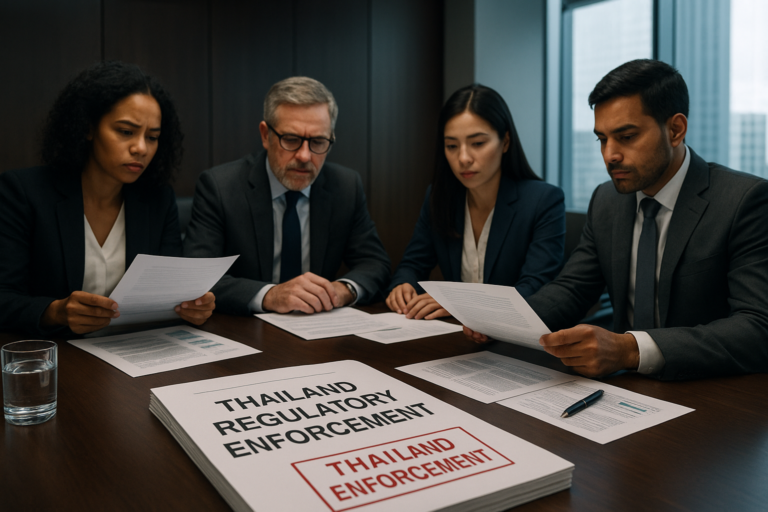
The key signal is the intensification of regulatory enforcement in Thailand, reflecting a shift toward stricter governance that signals increased scrutiny for businesses operating within the country. This development matters because it alters the risk landscape for investors by embedding greater compliance costs and operational uncertainty into Thailand’s business environment. Understanding the nuances of Thailand’s regulatory crackdown is essential for institutional investors and market participants evaluating sector exposures and strategic positioning in the Thai economy.
Investors must interpret this development as an indicator of evolving policy emphasis, where regulatory frameworks may no longer be viewed as static but rather as dynamic forces shaping corporate behavior and market functioning. The regulatory crackdown in Thailand directly impacts specific sectors, particularly those historically prone to compliance gaps, thereby reshaping sectoral attractiveness and potentially influencing capital allocation decisions.
Key Facts
- The Thai government has initiated a more rigorous regulatory enforcement campaign affecting domestic and foreign businesses.
- The crackdown targets enhanced compliance in sectors with significant prior violations or reputational risks.
- This initiative involves multiple regulatory authorities coordinating efforts to ensure adherence to existing laws and guidelines.
- The regulatory tightening includes enhanced monitoring, investigations, and penalties for non-compliance.
- Exact policy adjustments or reforms driving the crackdown remain unspecified; the emphasis is on enforcement rather than legislative changes.
Why It Matters
Stricter regulatory enforcement reallocates risk profiles within Thailand’s investment landscape by increasing compliance burdens and uncertainty around operational continuity. Businesses, particularly those with opaque governance or weak adherence to regulatory standards, face elevated costs and reputational risks, potentially reducing profit margins and creditworthiness.
For investors, this signals a recalibration in risk premiums demanded for Thailand-exposed assets, especially in sectors with higher scrutiny. The stricter regulatory environment could lead to a short-term increase in operational disruptions or litigation risks, affecting earnings stability.
The emphasis on enforcement over reform means that regulatory risk is less about future legislative shifts and more about consistency and predictability in the current legal framework. This adjustment influences judgments around Thai baht stability and foreign direct investment flows, as investor confidence hinges on governance clarity and enforceability.
Investment Implications
Investors and market participants need to account for potentially elevated compliance costs when assessing valuations for Thai companies operating in affected sectors. Enhanced regulatory risks may translate into capital expenditure on compliance infrastructure, slower project approvals, or more conservative management guidance.
Credit risk assessments are likely to incorporate greater weight on legal and regulatory adherence histories when underwriting corporate debt or equity positions. For foreign investors, the crackdown signals a more challenging due diligence environment requiring deeper scrutiny on governance standards and regulatory track records.
Capital allocation strategies might increasingly favor sectors or companies with demonstrated compliance cultures and transparent operational models to mitigate enforcement-related risks. Conversely, sectors with historically lax compliance may experience investor retrenchment or higher cost of capital.
Sector Impact
Positive
- Financial Services: Heightened regulatory oversight can strengthen confidence in the banking and insurance sectors by improving transparency and reducing systemic risks.
Neutral
- Energy: The crackdown does not directly alter regulatory frameworks specific to energy but increases operational vigilance on compliance.
Risk
- Manufacturing and Real Estate: These sectors may confront increased enforcement actions due to environmental or construction compliance issues, raising project risk profiles.
- Technology and Telecoms: Regulatory scrutiny related to data protection and licensing could increase legal and reputational risks.
Strategic Signals
This regulatory crackdown signals a strategic shift in Thailand’s governance approach from relying primarily on self-regulation to active enforcement. This evolution underscores a tightening business ecosystem where operational resilience and regulatory adherence are central competitive factors.
It reveals a government prioritizing institutional integrity and market discipline, which may improve Thailand’s credibility among international investors over the medium term while intensifying near-term compliance costs. The multi-agency coordination aspect indicates a systemic reinforcement rather than isolated enforcement, signaling a durable policy stance.
Thailand’s positioning as an ASEAN investment destination is thereby being recalibrated, emphasizing regulatory stability and rule of law as critical differentiators amid regional competition.
ASEAN Context
This development appears primarily domestic in nature with limited immediate ASEAN-wide implications.
Risks
The primary risks include operational disruptions for companies under investigation, increased legal expenses, and potential delays in project execution. In the absence of new legislative frameworks, market uncertainty may stem from inconsistent enforcement interpretations or uneven application across sectors.
Investor sentiment could be dampened by perceived increases in regulatory vulnerability, especially if compliance requirements escalate without clear guidance. Firms failing to adapt efficiently face reputational damage and financial strain.
Bottom Line
The regulatory crackdown in Thailand marks a significant inflection point in the country’s governance landscape, intensifying enforcement with tangible implications for corporate risk and compliance costs. It reshapes sector risk profiles, notably elevating scrutiny in manufacturing, real estate, and technology sectors, while potentially enhancing trust in financial services. Institutional investors and market participants must integrate this recalibrated regulatory risk into their valuation and risk management processes to optimize Thailand exposure.
Complete Guide
For a broader investment framework, continue with the Thailand Macro Investment Guide 2026.
Thailand Investor Brief PRO
Want deeper institutional-grade Thailand market intelligence?
Thailand Investor Brief PRO delivers three daily briefings with strategic market analysis, investment implications, and ASEAN intelligence beyond the public news cycle.
Related Thailand Investment Intelligence
- Thailand Investment Approval Scheme Signals Strategic Focus on Quality FDI
- Bank of Thailand Monetary Policy: Key Signals for Investors and Market Dynamics
- Thailand Foreign Investor Minimum Capital Requirements: Key Policy Implications for Investors
- Thailand vs Vietnam: A Strategic Comparison for Online Business and Manufacturing Investment
- Thailand vs Malaysia for Tourism Investment: Strategic Insights for 2026
Frequently Asked Questions
Why does this development matter for Thailand investors?
This development matters because it may affect Thailand’s investment environment through policy direction, sector exposure, trade dynamics, capital allocation, or ASEAN market positioning.
Which sectors could be affected?
The most relevant sectors depend on the specific development, but investors should assess exposure across policy-sensitive industries, financial services, trade-linked sectors, infrastructure, property, tourism, energy, and ASEAN-facing businesses.
How does this affect Thailand’s position in ASEAN?
The ASEAN impact depends on whether the development changes regional competitiveness, cross-border investment, supply chains, or investor sentiment. Thailand’s role should be assessed relative to nearby markets such as Singapore, Malaysia, Vietnam, Indonesia, and Cambodia.
What should investors watch next?
Investors should watch implementation details, policy follow-through, sector-level responses, corporate earnings signals, regulatory changes, and whether the development creates measurable shifts in demand, costs, or capital flows.