Executive Summary
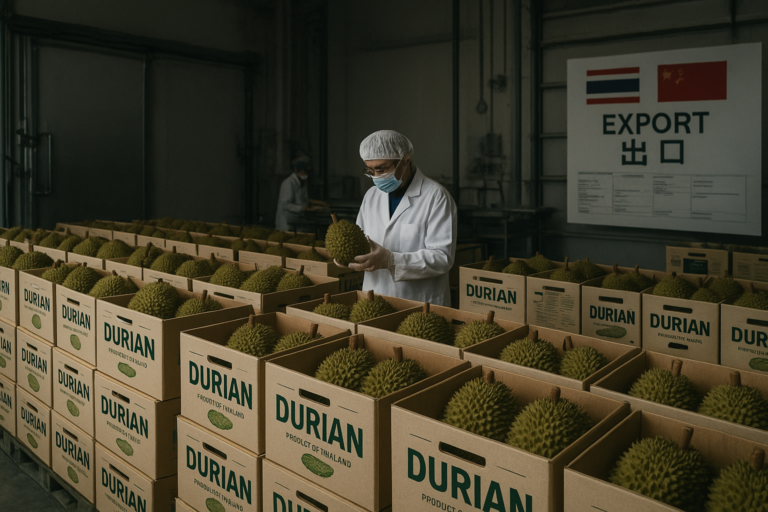
The key signal is the strengthening of Thailand’s durian export relationship with China, which highlights the country’s evolving role as a critical supplier in high-demand agricultural commodities within the ASEAN-China trade nexus. This development signals robust demand-side shifts within China that underscore Thailand’s export dependency on select premium agricultural products, notably durian, positioning Thailand as a specialized regional supplier.
For investors, this intensification of Thailand durian exports to China matters because it indicates how commodity-specific trade flows influence Thailand’s trade balance and export-driven sectors, with potential ripple effects on currency valuation, logistics infrastructure, and agribusiness profitability. Understanding this dynamic allows for nuanced insight into sectors most affected by China’s consumption patterns and trade policies, as well as the risks embedded in commodity concentration.
In a broader macro context, Thailand’s durian export expansion to China serves as a strategic indicator of Thailand’s integrated supply chain role and the resilience or vulnerability of its agricultural export sectors under evolving bilateral trade relations. It also reflects on Thailand’s capacity to leverage product-specific value chains within ASEAN export frameworks to capture premium market segments abroad.
Key Facts
- Thailand significantly increased durian exports to China, reflecting strong demand from Chinese consumers.
- The durian export growth is a notable contributor to Thailand’s agricultural export earnings.
- China remains a dominant destination for Thailand’s durian, reinforcing bilateral agricultural trade ties.
- Export volume increases coincide with Thailand’s broader export diversification efforts.
Why It Matters
Thailand’s rising durian exports to China underscore the country’s strategic positioning in high-value fruit exports, directly affecting trade balances and rural income streams. This commodity-specific export growth signals Thailand’s ability to meet rising Chinese demand for exotic fruits, enabling export earnings to remain resilient despite broader global trade uncertainties.
The export trend highlights Thailand’s agricultural sector competitiveness regarding product quality, supply chain management, and market access in China. From a macroeconomic viewpoint, steady foreign currency inflows from durian exports can support the Thai baht and reduce reliance on commodity inputs with volatile prices.
The focus on durian exports also indicates sectoral concentration risks where demand fluctuations or regulatory changes in China could disproportionately impact Thailand’s export revenues. The dependence on China as the primary export market for durian underscores geopolitical and trade policy risks inherent in bilateral trade concentration.
Investment Implications
For investors and market participants, the shift signals enhanced capital allocation opportunities into agribusiness segments specializing in durian cultivation, processing, and logistics. Companies with integrated supply chains and export capabilities stand to benefit from expanding access to Chinese consumers with strong purchasing power for premium fruit products.
The potential increase in durian-related trade volumes also pressures related infrastructure sectors, including cold storage, transport logistics, and cross-border trade facilitation, which may experience increased demand requiring capacity upgrades or efficiency improvements.
However, investors should consider foreign-exchange risks associated with revenue concentration from exports, as well as exposure to trade policy shifts impacting export licenses, phytosanitary standards, or tariffs. The durian export trend also underscores the need for diversification strategies within Thai export portfolios to mitigate overreliance on single markets or commodities.
Sector Impact
Positive
- Agriculture: Enhanced export demand for durian boosts income for growers and processors, increasing sector profitability.
- Logistics and Cold Chain: Growing export volumes create demand for improved storage and transport infrastructure specialized for perishable goods.
Neutral
- Currency Market: Indirect support for the Thai baht through export foreign currency inflows, but broader currency impacts depend on export diversification beyond durian.
Risk
- Agricultural Exporters: High dependency on one export commodity to one major destination introduces concentration risk.
- Trade Policy: Exporters remain sensitive to changes in Chinese regulatory frameworks or bilateral trade relations.
Strategic Signals
This development signals Thailand’s increasing specialization and supply chain integration in high-value tropical fruits catering specifically to Chinese consumption patterns. It reflects a targeted export strategy focusing on premium agro-commodities, which can position Thailand as an indispensable supplier within ASEAN’s broader commodity export framework.
Further, the durian export surge indicates Thailand’s ability to navigate complex phytosanitary and logistical barriers, creating a template for future product-specific export initiatives. This specialization, while lucrative, reveals Thailand’s balancing act between leveraging profitable niche markets and managing sectoral concentration risk.
ASEAN Context
This development appears primarily domestic in nature with limited immediate ASEAN-wide implications.
Risks
Concentration of exports in durian towards China exposes Thailand to fluctuations in Chinese demand driven by consumer preferences, economic conditions, or regulatory changes. Any tightening of Chinese import standards or geopolitical tensions could disrupt trade flows significantly.
Dependence on a single commodity also subjects exporters and related sectors to volatility from production shocks such as disease outbreaks or adverse weather conditions impacting durian yields.
Infrastructure bottlenecks in logistics or cold storage capacity could constrain future export growth if investments fail to keep pace with export volume expansion.
Bottom Line
Thailand’s durian export expansion to China signals a precise structural shift towards specialized agricultural exports embedded in premium consumer demand. This dynamic enhances export earnings and supports relevant sectors but introduces concentration risks for investors in Thailand’s trade-dependent economy. Strategic infrastructure investments and diversification remain critical to mitigating risks embedded in this export pattern.
Thailand Investor Brief
Stay Ahead of Thailand and ASEAN Markets
Explore Thailand Signal Capital’s flagship investor intelligence service,
including free market insights and premium daily briefings for investors,
executives, entrepreneurs, and ASEAN-focused professionals.
- Thailand and ASEAN market intelligence
- Investment implications and strategic signals
- FREE and PRO briefing options
Frequently Asked Questions
Why does this development matter for Thailand investors?
This development matters because it may affect Thailand’s investment
environment through policy direction, sector exposure, trade dynamics,
capital allocation, or ASEAN market positioning.
Which sectors could be affected?
The most relevant sectors depend on the specific development, but investors
should assess exposure across policy-sensitive industries, financial
services, trade-linked sectors, infrastructure, property, tourism, energy,
and ASEAN-facing businesses.
How does this affect Thailand’s position in ASEAN?
The ASEAN impact depends on whether the development changes regional
competitiveness, cross-border investment, supply chains, or investor
sentiment. Thailand’s role should be assessed relative to nearby markets
such as Singapore, Malaysia, Vietnam, Indonesia, and Cambodia.
What should investors watch next?
Investors should watch implementation details, policy follow-through,
sector-level responses, corporate earnings signals, regulatory changes,
and whether the development creates measurable shifts in demand, costs,
or capital flows.
Complete Guide
For a broader investment framework, continue with the Thailand Tourism Investment Guide 2026.