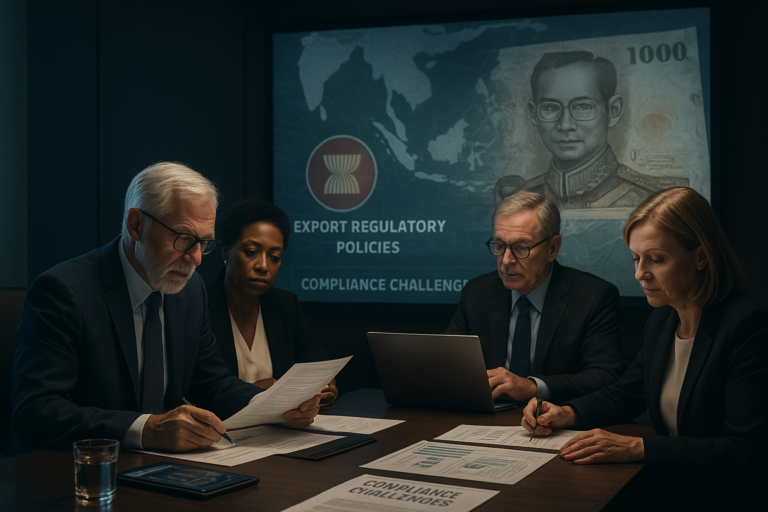
Executive Summary
The key signal is the heightened export regulatory risk in Thailand, which underscores amplified uncertainty in cross-border trade governance. For investors, this reflects increased potential variability in export revenue streams and cost structures, particularly in sectors heavily reliant on global trade flows. The prominence of Thailand export regulatory risk signals an evolving macroeconomic environment where the predictability of export performance may diminish, affecting capital allocation decisions and risk assessments.
This development matters because Thailand’s export sector is a pivotal component of its economic framework with direct links to currency stability, foreign exchange reserves, and listed companies’ earnings. Regulatory unpredictability can influence the operational planning of exporters, disrupt supply chains, and alter the competitive dynamics within ASEAN’s trading landscape. Understanding Thailand export regulatory risk is thus essential for international investors and corporate executives engaged in or evaluating exposure to Thailand’s export-dependent sectors.
Key Facts
- Thailand is experiencing increased export regulatory risk, introducing uncertainty in export rules and compliance requirements.
- This regulatory risk primarily impacts sectors dependent on cross-border trade, including manufacturing and agribusiness.
- The precise nature of the regulatory changes or their enforcement timeline remains unclear.
- Exporters face potential disruptions in operational costs and delays arising from regulatory shifts.
- The overall external economic environment and regional trade agreements continue to influence Thailand’s export policy context.
Why It Matters
Heightened Thailand export regulatory risk signals a macroeconomic tightening of the trade environment, with significant implications for economic stability and business operations. Exporters, which comprise a substantial share of Thailand’s GDP, may encounter higher compliance costs and unpredictable customs processes, increasing operational risk and lowering margins. This regulatory environment adds an additional layer of uncertainty that complicates exchange rate stability, as export flows partly underpin the Thai baht’s valuation.
The incorporation of regulatory risk into the business assessment framework reshapes both short-term and medium-term investment horizon considerations. Export disruptions could throttle revenue generation from international markets, diminishing profitability for listed exporters and influencing credit risk perceptions among lenders. From a broader economic perspective, constrained export activity may reduce foreign exchange inflows, impacting Thailand’s external balance and the government’s fiscal space.
Investment Implications
The emergence of export regulatory risk alters the risk-return calculus for capital allocation toward Thailand’s export-oriented sectors. Investors must factor in potential volatility in export volumes and profit margins driven by regulatory unpredictability. Businesses may adjust investment strategies, favoring activities less exposed to cross-border regulatory shifts or investing in compliance capabilities to mitigate risks.
Executives in manufacturing, agriculture, and export logistics will face challenges in cost forecasting and supply chain management, potentially leading to increased working capital requirements. Foreign investors evaluating Thailand as a regional export hub may reassess operational footprints in light of increased regulatory scrutiny and the attendant expense of non-compliance. Additionally, disruptions could cascade into borrowing costs and valuations of export-dependent listed companies.
Sector Impact
Positive
- Compliance and Legal Services: Increased demand for regulatory expertise and compliance solutions to navigate evolving export frameworks.
Neutral
- Domestic-focused Sectors: Sectors such as retail and construction less reliant on exports are unlikely to be directly affected.
Risk
- Manufacturing and Agribusiness: These sectors face elevated operational risks due to export regulatory unpredictability impacting costs and delivery timelines.
- Logistics and Supply Chain Operators: Exposure to regulatory bottlenecks may increase operational complexity and delay shipments.
Strategic Signals
The rise in Thailand export regulatory risk signals a potential recalibration in trade policy management, reflecting either an increased focus on non-tariff barriers or a response to geopolitical trade pressures. This shift may indicate an evolving government approach toward closer scrutiny of export activities, which has second-order effects on firms’ operational flexibilities and regional supply chain integration. Consequently, this elevates the importance of adaptive business models and regulatory engagement strategies within Thailand’s export sectors.
Furthermore, this development underscores the fragility of Thailand’s role as an ASEAN export hub under conditions of heightened regulatory complexity, urging a reevaluation of supply chain resilience and diversification strategies. The interplay between export regulatory risk and currency volatility adds a layer of systemic vulnerability to Thailand’s macroeconomic environment that investors must incorporate into their strategic outlook.
ASEAN Context
This development appears primarily domestic in nature with limited immediate ASEAN-wide implications.
Risks
Thailand’s export regulatory risk introduces execution risk linked to compliance uncertainty and potential enforcement inconsistency. These could disrupt business operations and delay shipments. The lack of clarity on regulation specifics enhances regulatory risk, complicating firm-level forecasting. Additionally, if export volumes decline, this may transmit external demand shocks into Thailand’s balance of payments and foreign exchange markets. Investors should recognize the translation of export regulatory risk into broader market and credit risks for export-dependent enterprises.
Bottom Line
The core investor takeaway is that rising Thailand export regulatory risk introduces measurable uncertainty into a key macroeconomic channel, affecting exporters’ operational stability and profitability. This necessitates recalibrated risk assessments for sector exposure and heightened attention to regulatory dynamics within Thailand’s export framework. Exporters’ role in currency stability and trade balance magnifies the economic consequences, making export regulatory risk a critical consideration for institutional investors and market participants engaged with Thailand.
Thailand Investor Brief
Stay Ahead of Thailand and ASEAN Markets
Explore Thailand Signal Capital’s flagship investor intelligence service,
including free market insights and premium daily briefings for investors,
executives, entrepreneurs, and ASEAN-focused professionals.
- Thailand and ASEAN market intelligence
- Investment implications and strategic signals
- FREE and PRO briefing options
Frequently Asked Questions
Why does this development matter for Thailand investors?
This development matters because it may affect Thailand’s investment
environment through policy direction, sector exposure, trade dynamics,
capital allocation, or ASEAN market positioning.
Which sectors could be affected?
The most relevant sectors depend on the specific development, but investors
should assess exposure across policy-sensitive industries, financial
services, trade-linked sectors, infrastructure, property, tourism, energy,
and ASEAN-facing businesses.
How does this affect Thailand’s position in ASEAN?
The ASEAN impact depends on whether the development changes regional
competitiveness, cross-border investment, supply chains, or investor
sentiment. Thailand’s role should be assessed relative to nearby markets
such as Singapore, Malaysia, Vietnam, Indonesia, and Cambodia.
What should investors watch next?
Investors should watch implementation details, policy follow-through,
sector-level responses, corporate earnings signals, regulatory changes,
and whether the development creates measurable shifts in demand, costs,
or capital flows.
Complete Guide
For a broader investment framework, continue with the Thailand Tourism Investment Guide 2026.