Executive Summary
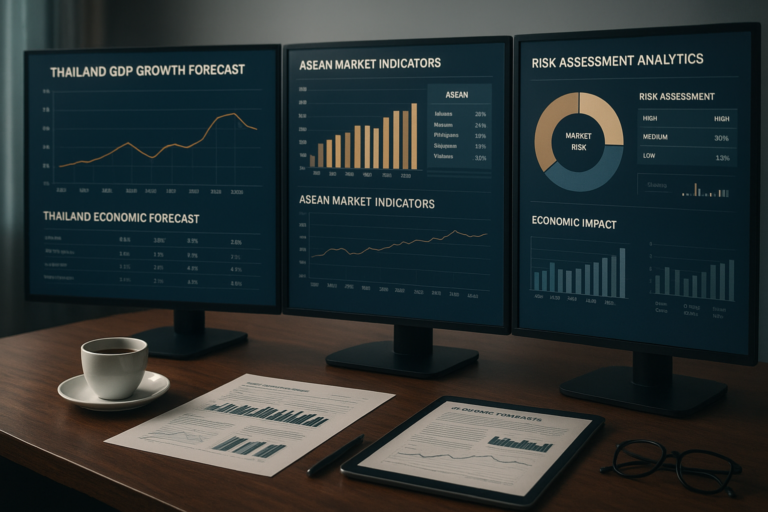
The key signal is the downward revision of Thailand’s GDP growth forecast for 2026, indicating a recalibration of economic expectations that has direct implications on investment strategy and risk assessment. This adjustment reflects shifts in underlying economic drivers and investor sentiment, signaling a potentially slower pace of economic expansion than previously anticipated. For investors, this signals tighter growth conditions in Thailand’s macroeconomic environment, affecting sectors tied to domestic consumption, export dynamics, and capital flows.
Understanding this revised trajectory is crucial for framing Thailand’s medium-term economic outlook and calibrating exposure to sectors sensitive to growth fluctuations, such as energy imports, tourism revenue, and listed companies with significant domestic earnings. The adjustment also reiterates Thailand’s positioning within ASEAN as an emerging market confronted with evolving global demand factors and structural challenges in sustaining growth momentum.
Key Facts
- Thailand’s GDP growth forecast for 2026 has been revised downward.
- The revision reflects updated macroeconomic assessments rather than immediate policy changes.
- No explicit changes to fiscal or monetary policy frameworks have been announced in relation to the revision.
Why It Matters
A downward revision in GDP growth for 2026 matters because it recalibrates investor expectations about the pace of economic expansion, which affects asset valuations, risk premium calculations, and capital allocation decisions. This signals that Thailand’s economic trajectory might experience slower momentum, impacting corporate earnings growth and consumption patterns. In turn, investors reliant on stable growth assumptions must reassess projections, especially those sensitive to domestic demand and external trade dynamics.
This matters for Thailand specifically as it influences borrowing costs indirectly through confidence channels, foreign direct investment flows, and local currency dynamics. Slow growth projections can limit revenue growth for listed companies, depress market liquidity, and constrain government fiscal space for investment and social expenditure, which are critical for long-term competitiveness within ASEAN.
Investment Implications
The revision affects investor behavior through altered risk perceptions and potential adjustments in portfolio allocations. Capital market participants may revise discount rates upward due to a more conservative growth outlook, impacting equity valuations of Thai listed companies, especially those with high domestic exposure. Sectors heavily dependent on consumer spending or external demand may face muted corporate profitability, influencing capital expenditure decisions and investment attractiveness.
For businesses, slower growth may translate into cautious hiring and capex plans, influencing related industries such as commercial property and banking through credit demand patterns. Entrepreneurs targeting expansion might face constrained market opportunities, requiring more stringent financial planning. Additionally, foreign investors evaluating Thailand must weigh the growth outlook against regional competitors within ASEAN, where divergent growth trajectories affect relative competitiveness.
Sector Impact
Positive
- Banking & Fintech: Conservative growth forecasts may stimulate demand for risk management and digital finance solutions as corporates and consumers adopt cautious financial strategies.
Neutral
- Energy: Impact remains limited as growth moderation may slightly reduce energy demand, but no major shifts expected absent policy changes.
Risk
- Tourism: Growth revision signals possible softer consumption, which could affect discretionary spending and inbound tourism revenue growth forecasts.
- Property: Slower growth may weigh on real estate demand, particularly commercial and residential segments reliant on economic confidence and income growth.
- Listed Companies: Earnings growth may be constrained, especially those with significant domestic market dependence.
Strategic Signals
The growth forecast revision signals a maturing phase in Thailand’s economic cycle, emphasizing the challenge of sustaining high growth rates amid global and domestic constraints. It highlights structural shifts that may necessitate a rebalancing of Thailand’s growth model away from traditional drivers toward increased productivity and innovation. The revision also conveys investor wariness regarding near-term economic resilience, influencing capital flow patterns and reinforcing the need for Thailand to strengthen its domestic economic foundations.
This development implicitly underscores the importance of monitoring how Thailand navigates external shocks, supply chain realignments, and evolving consumption behaviors, all of which collectively influence long-term investment attractiveness. It also suggests that Thailand’s public and private sectors may need to recalibrate strategies for economic diversification within the ASEAN economic landscape.
ASEAN Context
This development appears primarily domestic in nature with limited immediate ASEAN-wide implications.
Risks
The principal risks include potential amplification of investor caution, resulting in reduced foreign investment inflows and tighter financial conditions. Slower growth might impair corporate creditworthiness increasing default risk in vulnerable sectors. There is also risk that slower expansion constrains government fiscal flexibility, thereby affecting public investment programs crucial for infrastructure and competitiveness. However, specific policy or regulatory responses remain unclear, introducing uncertainty about the government’s adaptation capacity.
Bottom Line
The downward revision in Thailand’s GDP growth forecast for 2026 signals a tempered growth outlook with direct implications for investors’ growth assumptions, sector profitability, and risk assessments engaging the Thai economy. This adjustment prioritizes reassessment of exposure to domestic-demand-driven sectors and intensifies focus on corporate resilience amid a maturing economic cycle. The revised outlook further clarifies Thailand’s near-term economic challenges without indicating imminent policy shifts, offering a more cautious, yet realistic, framework for investment analysis.
Thailand Investor Brief
Stay Ahead of Thailand and ASEAN Markets
Explore Thailand Signal Capital’s flagship investor intelligence service,
including free market insights and premium daily briefings for investors,
executives, entrepreneurs, and ASEAN-focused professionals.
- Thailand and ASEAN market intelligence
- Investment implications and strategic signals
- FREE and PRO briefing options
Frequently Asked Questions
Why does this development matter for Thailand investors?
This development matters because it may affect Thailand’s investment
environment through policy direction, sector exposure, trade dynamics,
capital allocation, or ASEAN market positioning.
Which sectors could be affected?
The most relevant sectors depend on the specific development, but investors
should assess exposure across policy-sensitive industries, financial
services, trade-linked sectors, infrastructure, property, tourism, energy,
and ASEAN-facing businesses.
How does this affect Thailand’s position in ASEAN?
The ASEAN impact depends on whether the development changes regional
competitiveness, cross-border investment, supply chains, or investor
sentiment. Thailand’s role should be assessed relative to nearby markets
such as Singapore, Malaysia, Vietnam, Indonesia, and Cambodia.
What should investors watch next?
Investors should watch implementation details, policy follow-through,
sector-level responses, corporate earnings signals, regulatory changes,
and whether the development creates measurable shifts in demand, costs,
or capital flows.
Complete Guide
For a broader investment framework, continue with the Thailand Tourism Investment Guide 2026.