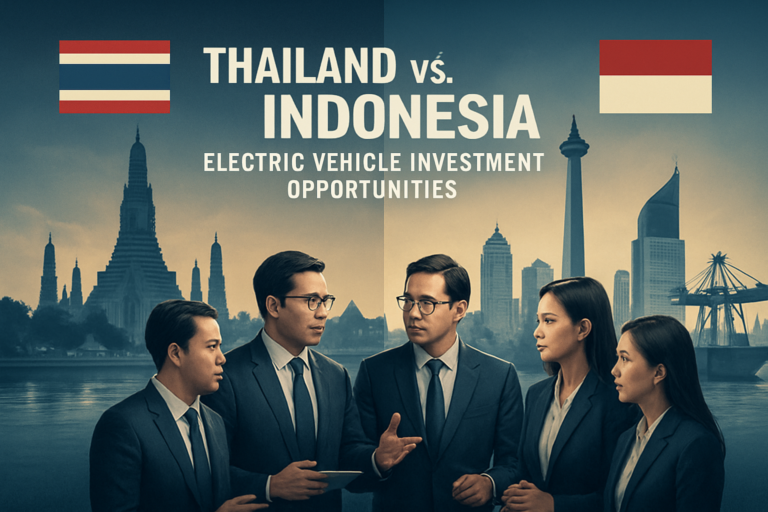
Executive Summary
The decision between Thailand vs Indonesia EV investment hinges on a nuanced assessment of automotive manufacturing maturity, battery supply chain integration, government incentives, and resource availability. Thailand demonstrates structural advantages through a well-established automotive ecosystem, robust infrastructure, and strategic regional positioning. Conversely, Indonesia’s strengths derive from its abundant critical mineral resources and aggressive government incentives targeting battery production and integration, attracting investors aiming to capitalize on raw materials and supply chain verticalization.
The choice of investment locale depends heavily on investor priorities: automotive manufacturers prioritizing integrated, efficient industrial clusters and logistics may find Thailand more suitable, while battery producers and firms focused on upstream mineral processing could benefit from Indonesia’s resource base and evolving policy landscape. Regulatory environments, execution risks, and political dynamics remain key considerations impacting capital deployment and operational stability in both markets.
Key Facts
- Economy: Thailand’s GDP reflects a diversified and moderately industrialized economy, while Indonesia’s larger population and resource base offer scale advantages but with higher regulatory complexity.
- Regulation: Both countries provide EV-related incentives, yet Indonesia’s programs emphasize mineral processing and battery manufacturing, whereas Thailand offers incentives aligned with automotive assembly and parts production.
- Infrastructure: Thailand benefits from developed transport logistics, port facilities, and industrial parks tailored for automotive production; Indonesia’s infrastructure is improving but remains less concentrated.
- Costs: Operational costs in Indonesia are often lower, particularly labor, but efficiency and supply chain maturity can be challenging.
- Investment Climate: Thailand is considered more predictable with established industrial regulations; Indonesia’s climate is evolving rapidly with reform efforts but carries greater uncertainty.
- Market Access: Thailand’s central geographic location offers better ASEAN market access; Indonesia’s archipelagic geography presents logistical hurdles.
- Workforce: Thailand has a skilled labor force with automotive experience; Indonesia has a larger labor pool but skills in advanced manufacturing are still developing.
- Foreign Ownership: Thailand has moderate foreign ownership limits but offers frameworks for investment; Indonesia imposes certain restrictions but has been progressively opening key sectors.
Comparison Analysis
The supplied research indicates that Thailand’s EV investment environment favors firms with established automotive manufacturing requiring integrated supply chains and stable regulatory conditions. Indonesia’s advantages lie primarily in securing upstream resources critical to EV batteries, driven by its mineral wealth and government policies incentivizing local value addition. This structural difference implies diverse risk-return profiles and operational considerations for investors.
From a supply chain perspective, Thailand’s mature clusters facilitate efficient vehicle assembly with established parts suppliers, whereas Indonesia’s value proposition is contingent on developing battery production capacity linked to critical minerals like nickel and cobalt. Both countries offer investment incentives; Thailand’s are more predictable with established frameworks, while Indonesia’s are evolving and more aggressive but accompanied by regulatory shifts.
| Factor | Thailand | Indonesia |
|---|---|---|
| Economy | Diversified, industrialized | Resource-driven, larger scale |
| Market Size | Moderate, export-focused | Large domestic market potential |
| Infrastructure | Advanced, automotive-focused | Developing, archipelago constraints |
| Taxation | Stable, incentive-driven | Competitive, evolving |
| Regulation | Predictable, supportive | Reform-driven, uncertain |
| Logistics | Efficient, regional hub | Challenging, improving |
| Labour | Skilled, automotive experience | Cost-effective, less skilled |
| Competitiveness | Industrial cluster strength | Resource base advantage |
| Investment Incentives | Automotive & assembly focused | Battery & mineral processing focused |
| Supply Chains | Established multi-tier suppliers | Developing battery supply chains |
| Political Stability | Moderate risk | Higher risk, reform underway |
| ESG Readiness | Progressive measures | Emerging standards |
| Skilled Labour | Available, experienced | Growing but limited |
| Industrial Clusters | Well-developed automotive parks | Emerging battery industrial zones |
For EV investors, Thailand’s integrated manufacturing ecosystem aligns with priorities on operational efficiency and supply chain reliability, particularly for vehicle assemblers and component manufacturers. Indonesia’s offering appeals to investors seeking to leverage critical mineral deposits and participate in battery chemical processing, with higher risk tolerance for regulatory evolution.
Thailand’s strategic location as a regional automotive hub provides it with long-term ASEAN positioning advantages, while Indonesia’s resource-driven approach positions it as a key upstream player with potential to ascend the EV value chain vertically. Investors should weigh policy stability, infrastructure maturity, and workforce readiness alongside cost dynamics when allocating capital.
Decision Framework
Investors focused on infrastructure robustness, industrial cluster maturity, and a skilled workforce are likely better suited to Thailand. The country’s established automotive manufacturing base and logistics connectivity support operational scale and supply chain complexity with fewer execution risks.
By contrast, investors prioritizing cost competitiveness, access to critical minerals, and a growing domestic market may find Indonesia more attractive, provided they have capacity to navigate regulatory uncertainties and evolving infrastructure constraints. Speed to market may be constrained by these factors but Indonesia offers longer-term growth potential in upstream battery production.
Automotive executives aiming to expand assembly footprint and component production should assess Thailand’s advantages in industrial maturity and supply chain depth. Battery producers and chemical processors seeking to integrate mineral extraction may lean towards Indonesia for proximity to resources and targeted government incentives.
Changing policy clarity, infrastructure development pace, and workforce skill improvements could modify this framework, necessitating ongoing monitoring of government announcements and investment regulations in both countries.
Investment Implications
Thailand’s stable industrial ecosystem, coupled with government incentives aligned to automotive assembly and parts manufacture, benefits investors seeking operational predictability and supply chain efficiency. Multinational automakers expanding EV production platforms may find Thailand a less risky environment for capital deployment relative to emerging peers.
Indonesia’s abundant critical minerals and recent policy initiatives to boost battery manufacturing attract investment into upstream EV value chains. This benefits investors focusing on raw material sourcing and chemical battery components, albeit with the trade-off of higher execution and regulatory risk. The large domestic market also provides potential scale advantages for finished EV products but remains constrained by logistics.
Capital allocation decisions should consider these trade-offs, balancing short- to medium-term execution risks against longer-term resource security and policy momentum. Investors enhancing regional ASEAN exposure must evaluate geographic positioning and supply chain integration needs alongside cost and incentive structures.
Portfolio strategies may benefit from diversified exposure to both markets, leveraging Thailand’s operational stability and Indonesia’s resource access to hedge regional and sector-specific risks.
Sector Impact
Manufacturing
Thailand’s mature automotive manufacturing clusters offer an established platform for EV assembly and component production, supporting manufacturers requiring integrated supplier networks and superior infrastructure. Indonesia’s manufacturing sector, while developing, is more focused on battery component and mineral processing, reflecting its upstream resource advantage.
Logistics
Thailand’s advanced logistics infrastructure and regional connectivity enhance supply chain reliability and reduce operational risks. Indonesia’s archipelagic geography poses logistic challenges that increase complexity and cost, impacting just-in-time manufacturing and distribution efficiency.
Strategic Signals
Thailand continues to strengthen its role as an automotive hub, evidenced by stable incentives and infrastructure investment focused on EVs, signaling confidence in industrial continuity. Indonesia’s recent aggressive policy shifts towards battery and mineral processing reflect a strategic pivot to capture upstream EV value chains, albeit with higher policy execution uncertainty.
Investor signals point to differentiated strategies: Thailand targeting integrated manufacturing and supply chains, Indonesia emphasizing resource leverage and battery ecosystem development. Both countries’ efforts to enhance ESG frameworks and regulatory transparency are critical to sustaining investor interest.
ASEAN Context
Within ASEAN integration efforts, Thailand’s central location and ASEAN Free Trade Area membership support cross-border automotive supply chains and export orientation, reinforcing its role as a regional manufacturing hub. Indonesia’s resource wealth complements ASEAN ambitions for a vertically integrated EV supply chain, although internal logistics and regulatory reforms remain obstacles.
Foreign direct investment flows in EV sectors increasingly consider ASEAN-wide value chains, with Thailand serving as a manufacturing base and Indonesia providing resource and battery production capabilities. Cross-border synergies between the two markets illustrate a complementary rather than a strictly competitive positioning within ASEAN EV investment strategies.
Risks
Regulatory risks are moderate in Thailand with relatively predictable policies but remain elevated in Indonesia amid ongoing reforms targeting mineral export and battery manufacturing regulations. Political risk is higher in Indonesia due to evolving governance dynamics, impacting investor confidence.
Currency risks in both countries require monitoring, with Indonesia generally experiencing higher volatility affecting cost structures and repatriation of capital. ESG risks are emerging considerations, particularly for Indonesia’s mineral extraction and processing sectors, which face scrutiny over environmental and community impacts.
Execution risks in Thailand pertain mainly to adapting existing facilities for EV technologies, whereas Indonesia’s risks relate to infrastructure development and regulatory clarity. Macro risks including global demand cycles and commodity price fluctuations also influence the investment outlook.
Decision Scorecard
| Factor | Thailand | Indonesia |
|---|---|---|
| Infrastructure Readiness | Strong | Developing |
| Labour Cost Advantage | Moderate | Strong |
| Skilled Labour Availability | Strong | Developing |
| Logistics Efficiency | Strong | Developing |
| Investment Incentives | Moderate | Strong |
| Regulatory Predictability | Strong | Higher Risk |
| Supply Chain Depth | Strong | Developing |
| Long-Term Strategic Fit | More Suitable | Suitable with Risk |
Thailand’s strengths in infrastructure, skilled labor, and regulatory stability make it more suited for investors prioritizing operational efficiency and supply chain integration. Indonesia, while offering cost advantages and incentives, is more suitable for investors willing to manage evolving risks associated with resource-driven EV sectors.
Bottom Line
Thailand is better suited for EV investors emphasizing integrated manufacturing, established automotive supply chains, and stable execution environments. Firms valuing predictability and operational maturity will likely favor Thailand as a regional EV hub.
Indonesia appeals to investors focused on upstream battery production and critical mineral value chains, prioritizing cost advantages and resource access despite increased regulatory and political risks. It offers higher growth potential for those able to manage evolving complexities.
Institutional investors should closely monitor regulatory developments, government incentive updates, infrastructure projects, and workforce enhancement initiatives in both countries. These factors will significantly influence execution risk and investment returns in the dynamic ASEAN EV market landscape.
Thailand Investor Brief
Stay Ahead of Thailand and ASEAN Markets
Explore Thailand Signal Capital’s flagship investor intelligence service,
including free market insights and premium daily briefings for investors,
executives, entrepreneurs, and ASEAN-focused professionals.
- Thailand and ASEAN investment intelligence
- Decision-oriented market and policy analysis
- FREE and PRO briefing options
Related Thailand Investment Intelligence
- Best ASEAN Country for Manufacturing Investment: Infrastructure and Supply Chain Comparison
- Thailand Automotive Exports Signal Growth in Hyundai BEV Supply Chain for Australia
- Thailand EV Manufacturing Supply Chains: Strategic Policy Signals and Investment Implications
- Best ASEAN Country for Manufacturing Investment: Costs, Incentives and Investor Returns
Frequently Asked Questions
Is Thailand a better investment destination than Indonesia?
Thailand may be more attractive for some investors, while Indonesia may offer advantages for others. The right choice depends on sector, risk tolerance, cost structure, market access needs, regulatory exposure, and long-term ASEAN strategy.
What are the main differences between Thailand and Indonesia for investors?
The main differences usually involve policy direction, operating costs, infrastructure depth, workforce availability, sector maturity, foreign ownership rules, supply chain positioning, and exposure to regional demand.
Which sectors are most relevant in this comparison?
The most relevant sectors depend on the topic, but common areas include Manufacturing, Energy, Property, Tourism, Banking, Fintech, Infrastructure, Logistics, Exports, and ASEAN Supply Chains.
How should foreign investors use this comparison?
Foreign investors should use this comparison to identify where Thailand has structural advantages and where another market may offer better conditions. The most important factors are regulatory stability, execution risk, market access, cost competitiveness, and long-term economic direction.
What should investors watch next?
Investors should monitor policy implementation, foreign investment rules, sector incentives, currency conditions, infrastructure development, corporate earnings signals, demand trends, and regional competition.
Complete Guide
For a broader investment framework, continue with the Thailand Energy Investment Guide 2026.