Executive Summary
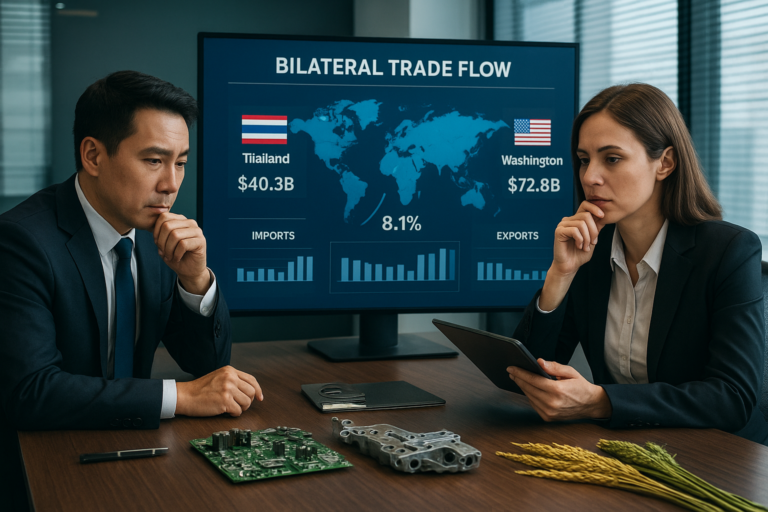
The key signal is a discernible shift in export confidence between the U.S. and Thailand, indicating evolving trade dynamics that directly shape Thailand’s export sector outlook and related macroeconomic variables. This development matters because export confidence affects Thai exporters’ operational planning and currency stability, which in turn influences business decisions and investment approaches within sectors tethered to U.S. demand. For investors, understanding this movement is crucial in evaluating Thailand’s external trade resilience and identifying exposures related to U.S.-linked export revenues.
Key Facts
- The source material explicitly addresses changes in the confidence surrounding exports between the United States and Thailand.
- The development concerns macroeconomic trade confidence without specifying particular reforms, trade volume changes, or regulatory shifts.
- No detailed figures on export volumes, trade balance, or sector-specific impacts are provided.
- Uncertainty remains regarding the drivers behind the export confidence change and how it will translate into operational or policy responses.
Why It Matters
This change in export confidence is significant as it reflects evolving perceptions about the stability and reliability of Thailand’s export performance to the U.S., a major trade partner. Shifts in confidence can influence exporters’ willingness to engage in new contracts, adjust production cycles, and manage supply chains. The Thai baht’s value is commonly sensitive to export expectations, so confidence shifts can affect currency flows and financial market dynamics. These factors collectively alter the investment environment by affecting risk assessment and business strategies tied to bilateral trade.
Investment Implications
The evidence shapes an investment context where Thailand’s exporters linked to the U.S. market face a changed backdrop of demand expectations. Market participants directly exposed include companies concentrated in sectors such as electronics, automotive parts, and agriculture, which traditionally have strong U.S. trade links. The development adjusts the operating environment by influencing export-related cash flow predictability and foreign exchange exposure through the Thai baht’s sensitivity to U.S. trade perceptions. However, the source content does not clarify how investors are pricing this change or if it will affect capital flows or borrowing costs.
Sector Impact
Neutral
- Electronics and Electrical Appliances: Exposure to U.S. export confidence changes is notable but the impact direction and scale remain unspecified.
- Automotive and Parts Manufacturing: These sectors are linked to U.S. trade, though the source does not quantify specific effects.
- Agriculture and Food Processing: U.S. export confidence may influence these exporters without detailed impact evidence.
Strategic Signals
The development signals a marketplace sensitivity to international trade relationships and trade sentiment between Thailand and the U.S., underscoring the strategic importance of maintaining stable trade conditions. It reflects underlying vulnerabilities or shifts in trade environment confidence rather than established policy changes. This situation highlights the need for stakeholders to consider the robustness of the trade linkage as a strategic factor.
ASEAN Context
This development appears primarily domestic in nature with limited immediate ASEAN-wide implications.
Risks
The source does not specify the underlying causes or duration of the export confidence shift, creating uncertainty about the persistence or reversal of these sentiments. There is no information on whether institutional or policy measures will address this change or how effectively market participants can adapt. These ambiguities represent material uncertainty for investors and businesses reliant on U.S.-Thailand trade dynamics.
Bottom Line
The key established signal is a shift in U.S.-Thailand export confidence signaling changes in trade environment perceptions. This carries direct relevance for Thailand’s exporters with U.S. exposure and impacts on currency-sensitive financial conditions. The available evidence does not clarify underlying drivers or corrective actions, leaving significant uncertainty regarding the medium-term trade and economic implications.
Thailand Investor Brief
Stay Ahead of Thailand and ASEAN Markets
Explore Thailand Signal Capital’s flagship investor intelligence service,
including free market insights and premium daily briefings for investors,
executives, entrepreneurs, and ASEAN-focused professionals.
- Thailand and ASEAN market intelligence
- Investment implications and strategic signals
- FREE and PRO briefing options
Frequently Asked Questions
Why does this development matter for Thailand investors?
This development matters because it may affect Thailand’s investment
environment through policy direction, sector exposure, trade dynamics,
capital allocation, or ASEAN market positioning.
Which sectors could be affected?
The most relevant sectors depend on the specific development, but investors
should assess exposure across policy-sensitive industries, financial
services, trade-linked sectors, infrastructure, property, tourism, energy,
and ASEAN-facing businesses.
How does this affect Thailand’s position in ASEAN?
The ASEAN impact depends on whether the development changes regional
competitiveness, cross-border investment, supply chains, or investor
sentiment. Thailand’s role should be assessed relative to nearby markets
such as Singapore, Malaysia, Vietnam, Indonesia, and Cambodia.
What should investors watch next?
Investors should watch implementation details, policy follow-through,
sector-level responses, corporate earnings signals, regulatory changes,
and whether the development creates measurable shifts in demand, costs,
or capital flows.
Complete Guide
For a broader investment framework, continue with the Thailand Tourism Investment Guide 2026.