Executive Summary
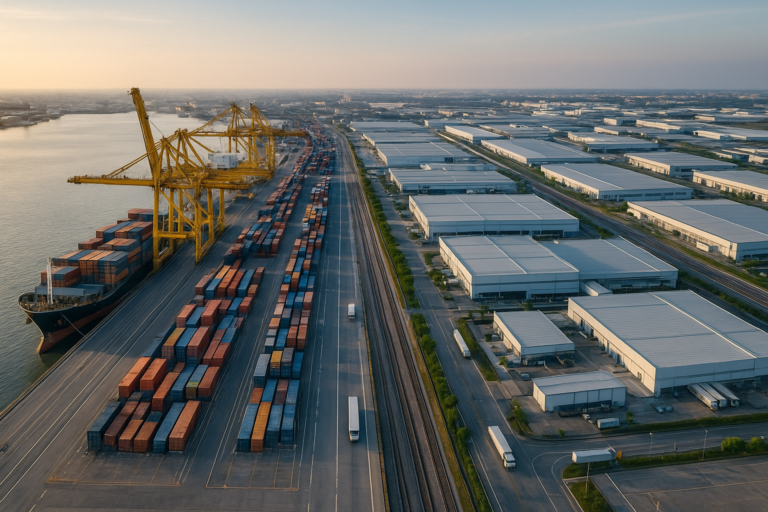
The key signal is the strategic enhancement of Thailand’s transport infrastructure with a concentrated focus on seaports and logistics hubs. This development signifies a deliberate push towards reinforcing Thailand’s role as a critical logistics and maritime gateway in ASEAN, directly influencing property markets adjacent to these transport nodes. Investors need to evaluate how infrastructure-driven logistics enhancements optimize operational efficiencies, boost industrial land demand, and reconfigure supply chain dynamics in Thailand.
Transport infrastructure development in seaports and logistics points to increased competitiveness of Thailand’s industrial and commercial property sectors. This trend matters for investors as it underscores evolving spatial value creation linked to infrastructure capacity and connectivity improvements. The positioning of Thailand’s seaports as modern logistics platforms aligns with rising demand for industrial estates, warehouses, and container yards, presenting nuanced implications for capital allocation within property and logistics real estate assets.
Key Facts
- Development projects focus on expanding and upgrading seaport capacity and logistics infrastructure in Thailand.
- Efforts aim to integrate land and maritime transport more efficiently to support cargo throughput and supply chain reliability.
- Infrastructure improvements target reducing bottlenecks and increasing throughput speeds in key port areas.
- Property adjacent to these infrastructure nodes includes industrial estates, logistics parks, and commercial land.
- These upgrades are part of Thailand’s broader strategy to capitalize on its strategic location within ASEAN logistics corridors.
Why It Matters
Enhanced seaport and logistics infrastructure directly impacts the valuation and liquidity of property assets linked to transport nodes. In Thailand, industrial and logistics property sectors are particularly sensitive to infrastructure quality, which governs operational costs and supply chain reliability. Improved seaport capacity strengthens Thailand’s attractiveness for export-oriented industries and supports the rise of cross-border trade distribution centers.
This matters because investors’ cost of capital and asset returns increasingly depend on infrastructure-enabled efficiencies. The physical proximity to upgraded seaports and integrated logistics hubs translates to tangible benefits like shortened freight times and lower inventory holding costs, vital for sectors including manufacturing, e-commerce, and exports. Efficient port logistics can also anchor foreign direct investment by enabling firms to optimize their regional supply chains from Thailand, amplifying demand for supporting property infrastructure.
Investment Implications
For institutional investors and real estate developers, the transport infrastructure upgrades in seaports and logistics suggest a prioritization of industrial and logistics property zones near these hubs. These locations will likely experience heightened demand owing to their role in supply chain optimization and freight cost minimization. Capital allocation strategies should incorporate the emerging locational premiums associated with properties near modernized port infrastructure.
Operational businesses will witness adjustments in logistics cost structures, shifting part of their value chain closer to Thailand’s fortified maritime gateways. This could increase absorption rates in logistics parks and industrial estates proximate to ports and intermodal facilities. Investors should note that improved infrastructure reduces operational risk by mitigating congestion and capacity constraints, factors which traditionally depress asset performance in these sectors.
Risk pricing will increasingly reflect infrastructure dependency, implying that properties distant from improved transport assets may face relative discounting. Credit structures supporting developers or REITs linked to logistics-centric properties should reassess potential impacts from shifts in tenant demand driven by these infrastructure changes.
Sector Impact
Positive
- Property: Industrial estates and logistics parks adjacent to seaports will experience increased valuations and occupancy due to improved connectivity and throughput.
- Logistics and Warehousing: Enhanced port infrastructure enables more efficient freight movement, elevating demand for modern storage and distribution centers.
Neutral
- Commercial Real Estate: While improved transport infrastructure supports economic activity, direct impact on retail and office spaces remains limited unless tied to port-centric logistics development.
Risk
- Peripheral Property: Assets located far from upgraded transport nodes may face declining demand or valuation stagnation due to logistical inefficiencies.
Strategic Signals
This development signals Thailand’s commitment to fortifying its position as a regional logistics hub leveraging its geographical location. The emphasis on port and transport infrastructure modernization suggests a strategic priority to integrate maritime and inland logistics, supporting export competitiveness and supply chain resilience. This reflects a structural shift in Thailand’s property market where infrastructure proximity increasingly dictates asset quality and investment appeal.
Moreover, this indicates a potential acceleration of capital flows into transport-linked real estate, fostering clustering around upgraded seaports and logistics nodes. The consolidation of transport and property sectors around these nodes could create new ecosystem hubs that attract industrial users and global trading players seeking efficient ASEAN access.
ASEAN Context
The enhancement of Thailand’s seaports and transport infrastructure strengthens its role as a critical ASEAN logistics node, providing more reliable maritime gateways for regional and global trade flows. This development reinforces Thailand’s competitive positioning relative to neighboring countries in the Mekong sub-region and enhances regional value chain integration where Thailand serves as a key transshipment and logistics hub.
However, the direct ASEAN impact will depend on coordinated regional trade facilitation and infrastructure linkages extending beyond Thai borders. Thailand’s investment in seaports offers tangible advantages in ASEAN supply chain networks, but complementary inland and cross-border infrastructure remain crucial to fully realize these benefits.
Risks
- Execution Risks: Delays or cost overruns in infrastructure projects could postpone anticipated efficiency gains, affecting property sector dynamics.
- Demand Concentration: Over-reliance on seaport-adjacent properties risks exposure to sectoral shifts affecting export and logistics volumes.
- Competitive Risks: Regional competition from other ASEAN ports may limit throughput gains despite domestic infrastructure upgrades.
- Market Absorption: Rapid infrastructure expansion could outpace real estate demand if industrial and logistics tenancy growth is slower than expected.
Bottom Line
Thailand’s focused development of seaport and transport infrastructure communicates a strategic elevation of logistics and property sectors tightly linked to supply chain efficiencies. The resulting spatial premium in industrial and logistics properties near these hubs will reshape capital allocation patterns and asset valuation frameworks. For investors targeting Thailand’s property markets, infrastructure proximity is becoming a critical determinant of asset performance. The most important takeaway is that transport infrastructure upgrades create a new structural lens through which to assess Thailand’s property and logistics investment opportunities.
Thailand Investor Brief
Stay Ahead of Thailand and ASEAN Markets
Explore Thailand Signal Capital’s flagship investor intelligence service,
including free market insights and premium daily briefings for investors,
executives, entrepreneurs, and ASEAN-focused professionals.
- Thailand and ASEAN market intelligence
- Investment implications and strategic signals
- FREE and PRO briefing options
Frequently Asked Questions
Why does this development matter for Thailand investors?
This development matters because it may affect Thailand’s investment
environment through policy direction, sector exposure, trade dynamics,
capital allocation, or ASEAN market positioning.
Which sectors could be affected?
The most relevant sectors depend on the specific development, but investors
should assess exposure across policy-sensitive industries, financial
services, trade-linked sectors, infrastructure, property, tourism, energy,
and ASEAN-facing businesses.
How does this affect Thailand’s position in ASEAN?
The ASEAN impact depends on whether the development changes regional
competitiveness, cross-border investment, supply chains, or investor
sentiment. Thailand’s role should be assessed relative to nearby markets
such as Singapore, Malaysia, Vietnam, Indonesia, and Cambodia.
What should investors watch next?
Investors should watch implementation details, policy follow-through,
sector-level responses, corporate earnings signals, regulatory changes,
and whether the development creates measurable shifts in demand, costs,
or capital flows.
Complete Guide
For a broader investment framework, continue with the Thailand Tourism Investment Guide 2026.