Executive Summary
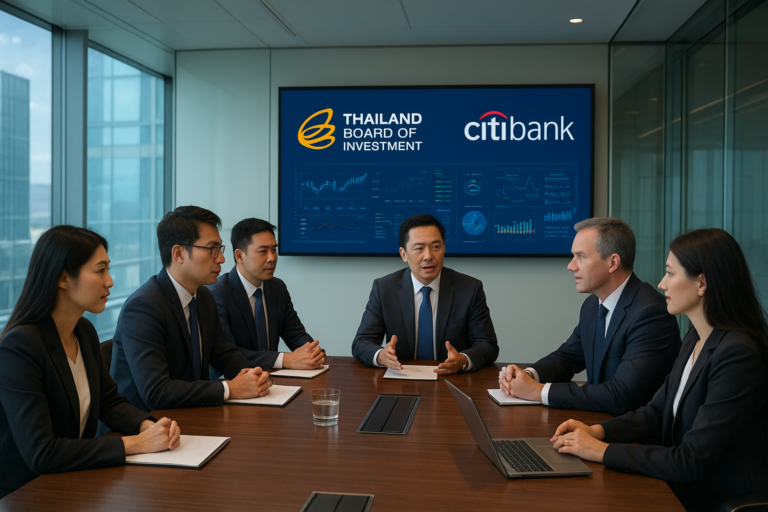
The key signal is the institutional deepening and strategic alignment between Thailand’s Board of Investment (BoI) and Citibank, indicating a more sophisticated approach to attracting and managing foreign direct investment (FDI). This partnership extends beyond traditional FDI promotion toward tailored financial and advisory services, suggesting that Thailand is positioning itself as an integrated investment hub with a streamlined pathway for international capital deployment.
This development matters because it enhances Thailand’s competitive framework by merging government facilitation with global financial expertise, directly impacting investor confidence and capital allocation decisions. It implies a maturation of the policy environment around FDI wherein financial institutions play a key role in investment facilitation and risk mitigation. Consequently, this sets a precedent for enhanced cross-sector collaboration in Thailand’s policy and investment ecosystem, which international investors need to factor into their strategic positioning.
From an investment intelligence standpoint, the keyword “BoI Citi partnership FDI Thailand” captures the essence of this evolving public-private dynamic that shapes Thailand’s attractiveness in the regional and broader ASEAN investment landscape.
Key Facts
- The Board of Investment (BoI) has entered a partnership with Citibank focused on facilitating foreign direct investment in Thailand.
- The collaboration aims to integrate BoI’s investment promotion capabilities with Citibank’s financial and advisory services.
- The partnership does not introduce new policy instruments but enhances investment facilitation and service delivery mechanisms.
- The initiative is positioned to improve investor experience by reducing friction in capital flows and investment management.
Why It Matters
This partnership signals a notable evolution in Thailand’s FDI promotion, transitioning from pure policy incentives to a hybrid model incorporating financial-sector engagement. By leveraging Citibank’s institutional expertise, Thailand creates a more investor-centric environment reducing operational and financial barriers for foreign investors. Such integration reduces uncertainty and supports smoother capital deployment processes, which are critical for larger and more complex FDI projects that require sophisticated financial structuring.
For Thailand, aligning the BoI with a global financial entity enhances the country’s image as a mature investment destination where market participants can expect superior facilitation services, not just incentives. This matters in a regional competition context where ASEAN countries strive to elevate their investment climate quality rather than rely solely on tax or subsidy advantages.
Investment Implications
Investors and businesses with interests in Thailand will observe an improved ease of doing business framework aligned with international financial standards. This may lead to more predictable capital flow management, reducing transactional risks associated with cross-border FDI deployment. For multinational corporations and financial investors, the partnership presents potential for streamlined access to sector-specific financial products or advisory tailored to Thai market conditions.
Executives engaged in strategic capital planning should account for this institutional mechanism as a potential enabler for faster project execution and risk mitigation. Entrepreneurs and local partners could also benefit from enhanced support networks for investment structuring and partnership facilitation.
While this development does not directly alter existing policies, it effectively lowers non-policy barriers, which tend to be significant determinants of FDI decisions in emerging markets.
Sector Impact
Positive
- Financial Services: The partnership directly enhances financial services offered to investors, improving capital access and transaction advisory within Thailand.
- Manufacturing and Technology: These sectors often require sophisticated investment structuring and financing, which the partnership can facilitate, improving project feasibility.
- Infrastructure and Real Estate: Large-scale projects stand to benefit from integrated advisory and investment facilitation mechanisms.
Neutral
- Tourism and Hospitality: While indirectly affected by broader FDI flows, these sectors have limited direct exposure to financial facilitation mechanisms under this partnership.
Risk
- SMEs: Smaller enterprises might not immediately access the enhanced facilitation services, limiting near-term benefit distribution across all business scales.
Strategic Signals
The alliance between BoI and Citibank signals a strategic shift toward embedding financial expertise within Thailand’s investment promotion infrastructure. This reveals an understanding by Thai policymakers that improving FDI flows increasingly depends on coordination between regulatory facilitation and market-based financial instruments. Such a model supports Thailand’s ambition to attract higher-quality FDI characterized by complex financial requirements and long-term capital commitments.
Furthermore, the development suggests a push to differentiate Thailand’s investment environment through service excellence and financial integration, potentially prompting other ASEAN members to reevaluate their institutional arrangements to compete more effectively for sophisticated investors.
ASEAN Context
This development appears primarily domestic in nature with limited immediate ASEAN-wide implications.
Risks
The implementation risk centers on the effectiveness of inter-institutional coordination between BoI and Citibank and the scalability of this model to accommodate a broad range of investors. There is also a risk that benefits concentrate among large or financially sophisticated investors, slowing broader FDI distribution. Additionally, without changes to policy frameworks, structural limitations on investment protection or market access remain unaddressed.
Bottom Line
The BoI-Citi partnership marks an important step toward integrating financial expertise within Thailand’s investment promotion environment, enhancing facilitation of complex FDI flows. This development improves institutional capacity to attract higher-value, sophisticated investors by reducing operational frictions. While its effects will be sector-specific and skewed towards larger projects, it raises the bar for investment facilitation within Thailand. Investors engaged in financial services, manufacturing, and infrastructure sectors are particularly positioned to benefit.
Thailand Investor Brief
Stay Ahead of Thailand and ASEAN Markets
Explore Thailand Signal Capital’s flagship investor intelligence service,
including free market insights and premium daily briefings for investors,
executives, entrepreneurs, and ASEAN-focused professionals.
- Thailand and ASEAN market intelligence
- Investment implications and strategic signals
- FREE and PRO briefing options
Frequently Asked Questions
Why does this development matter for Thailand investors?
This development matters because it may affect Thailand’s investment
environment through policy direction, sector exposure, trade dynamics,
capital allocation, or ASEAN market positioning.
Which sectors could be affected?
The most relevant sectors depend on the specific development, but investors
should assess exposure across policy-sensitive industries, financial
services, trade-linked sectors, infrastructure, property, tourism, energy,
and ASEAN-facing businesses.
How does this affect Thailand’s position in ASEAN?
The ASEAN impact depends on whether the development changes regional
competitiveness, cross-border investment, supply chains, or investor
sentiment. Thailand’s role should be assessed relative to nearby markets
such as Singapore, Malaysia, Vietnam, Indonesia, and Cambodia.
What should investors watch next?
Investors should watch implementation details, policy follow-through,
sector-level responses, corporate earnings signals, regulatory changes,
and whether the development creates measurable shifts in demand, costs,
or capital flows.
Complete Guide
For a broader investment framework, continue with the Thailand Tourism Investment Guide 2026.