Executive Summary
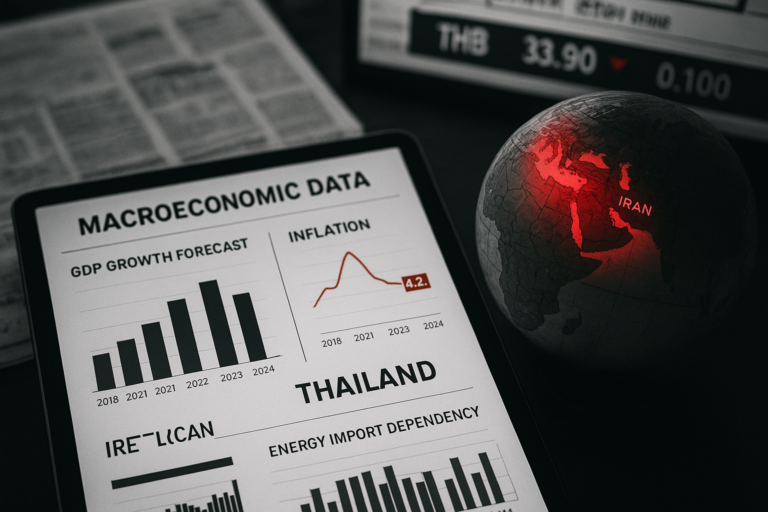
The key signal is that escalating tensions in the Iran conflict materially heighten Thailand’s vulnerability to external energy price shocks, undermining energy security and exerting downward pressure on GDP growth and upward pressure on inflation. For investors, this introduces increased macroeconomic volatility with implications for corporate earnings, currency stability, and market sentiment. The development signals that Thailand’s heavy dependence on oil and gas imports from volatile regions remains a critical structural economic risk that constrains growth prospects and amplifies inflationary pressures in the near term.
Key Facts
- Thailand is a major net importer of oil and gas, heavily reliant on energy imports to meet domestic demand.
- The Iran conflict has prompted a downward revision of Thailand’s GDP growth forecast to as low as 1.3%.
- Heightened inflationary pressures are anticipated due to potential increases in global energy prices stemming from geopolitical tensions.
Why It Matters
Thailand’s energy import dependency implies that geopolitical unrest in key oil-producing regions directly transmits to domestic macroeconomic outcomes. Rising oil and gas prices feed into broader inflation via higher transport, production, and utility costs. This inflation dilutes consumer purchasing power and raises operating costs for businesses across sectors, discouraging capital expenditure and dampening economic growth. The GDP downward revision to 1.3% reflects these headwinds, signaling a weaker economic environment that affects corporate profitability and government revenue forecasts.
For the Thai baht, rising import bills from elevated energy costs could exert depreciation pressure, complicating monetary policy and increasing the cost of foreign currency-denominated debt for Thai companies. This currency depreciation risk introduces volatility that can undermine investor confidence in emerging market assets.
Banking sector credit performance is also indirectly impacted as inflation erodes real incomes, potentially raising default risks on consumer loans and dampening loan growth.
Furthermore, prolonged inflation may push the Bank of Thailand to maintain or tighten monetary conditions, increasing borrowing costs for corporates and consumers, restraining investment and consumption.
These dynamics illustrate how the Iran conflict acts as a transmission mechanism for energy price shocks that deepen inflation and economic growth vulnerabilities specific to Thailand’s macroeconomic structure.
Sector Impact
- Risk: Energy-intensive manufacturing – Higher fuel and utility costs squeeze margins and reduce competitiveness amid weak growth.
- Risk: Consumer staples and retail – Inflationary pressures reduce disposable incomes, impacting consumption patterns negatively.
- Risk: Banking sector – Inflation and slower growth increase credit risk and may prompt tighter lending standards.
- Neutral: Tourism – While energy prices can influence travel costs, broader tourism recovery drivers may offset marginal cost increases in the short term.
- Neutral: Export sectors – Exporters face currency volatility and cost pressures but may gain from a weaker baht in external competitiveness.
ASEAN Context
This development appears primarily domestic in nature with limited immediate ASEAN-wide implications. However, Thailand’s economic slowdown and inflation pressures could reduce intra-ASEAN trade demand and investment flows. Meanwhile, ASEAN energy importers with similar vulnerabilities may experience analogous macro shocks, underscoring a regional sensitivity to Middle East geopolitical risks in energy markets.
Bottom Line
The Iran conflict underscores the fragility of Thailand’s energy security and macroeconomic stability due to import dependence on volatile regions. Investors should recognize that rising energy prices are not a transient shock but a structural risk affecting growth, inflation, corporate profitability, and currency stability. Market participants exposed to Thailand’s fixed income and equity markets should price in heightened volatility and potential risk premia linked to these geopolitical developments. The development reinforces the importance of monitoring energy-related cost pressures as a central factor shaping Thailand’s economic trajectory.
Thailand Investor Brief
Want deeper Thailand & ASEAN investor intelligence?
Join Thailand Investor Brief FREE
Unlock Thailand Investor Brief PRO
Complete Guide
For a broader investment framework, continue with the Thailand Tourism Investment Guide 2026.