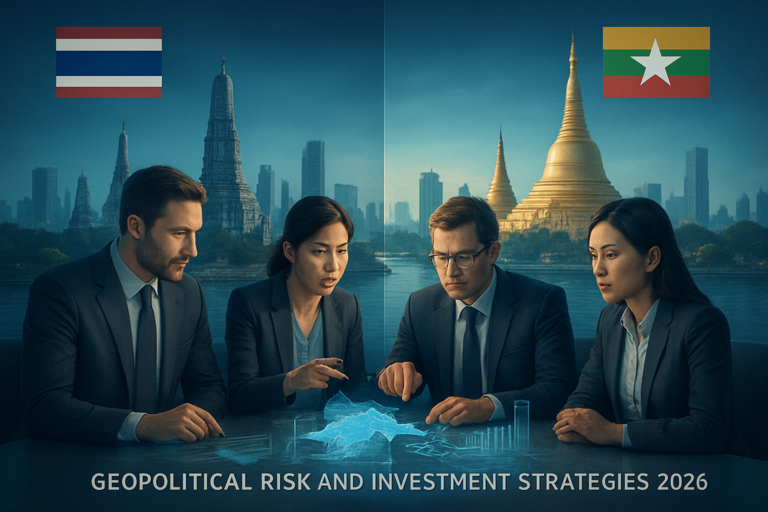
Executive Summary
As 2026 unfolds, Thailand and Myanmar present divergent geopolitical risk profiles shaped by their historical trajectories, governance frameworks, and regional dynamics. For international investors and ASEAN-focused professionals, understanding these differences is critical for strategically allocating capital and managing exposure to political volatility and economic opportunity. Thailand remains a relatively stable investment environment with ongoing political undercurrents but holds significant advantages in infrastructure and integration within ASEAN. Myanmar, despite its rich natural resources and strategic geographical position, continues to grapple with internal conflict and governance uncertainty, heightening its risk profile. This article offers a comprehensive comparison across economic fundamentals, market access, operational conditions, sectoral prospects, and geopolitical risks, providing a long-term perspective essential for prudent investment decisions.
Why This Comparison Matters
Thailand and Myanmar constitute critical nodes in Southeast Asia’s geopolitical and economic complex. Their proximity and shared border mean shifts in one country invariably impact the other, influencing regional stability, trade corridors, and labor flows. Investors seeking growth opportunities in ASEAN must weigh the contrasting geopolitical contexts, as risk-adjusted returns hinge on more than macroeconomic indicators. Understanding where political volatility constrains economic policy or disrupts supply chains can differentiate successful investments from costly miscalculations.
Investor Implication: A nuanced geopolitical risk analysis between Thailand and Myanmar helps investors align risk tolerance with strategic sectors and timeline, avoiding surprises from sudden political shifts or border disruptions that have lingered historically.
Economic and Business Environment
Thailand’s economy, characterized by open-market policies and diversified sectors, benefits from per capita income and GDP levels that decisively outpace Myanmar’s. Thailand’s growth trajectory has been buttressed by decades of incremental reforms fostering industrialization, infrastructure development, and a relatively robust legal framework. In contrast, Myanmar has experienced long periods of economic isolation and political turmoil that stifled institutional development and limited foreign investment inflows. Despite ongoing reforms, Myanmar’s economy remains vulnerable to political instability and infrastructural deficits.
Investor Implication: Thailand provides a more conducive environment for sustainable business operations and economic scalability, translating into lower operational uncertainty and more predictable returns. Myanmar’s economic upside accompanies higher volatility, appealing to investors with higher risk appetites seeking frontier market gains.
Foreign Investment and Market Access
Thailand benefits from well-established trade links, improved logistics infrastructure, and multiple free trade agreements within ASEAN and with major partners such as China, Japan, and the United States. Its public policies generally support foreign direct investment (FDI), albeit with some regulatory complexities especially concerning land ownership and foreign equity restrictions. Myanmar, strategically located between India, China, and Thailand, holds significant promise as a regional trade and manufacturing hub but suffers from constrained FDI due to sanctions, political uncertainty, and underdeveloped infrastructure.
Investor Implication: Thailand’s superior market access and preferential trade regimes reduce barriers and costs for cross-border business, critical for export-oriented investors. Myanmar may offer unique gateway opportunities to untapped resources and markets but demands stringent due diligence and risk mitigation strategies.
Cost, Talent, and Operating Conditions
Thailand’s labor force is relatively skilled, with evolving vocational and technical education improving workforce quality. While labor and operational costs have risen steadily, they remain competitive within the ASEAN context. Business infrastructure, utilities, and digital connectivity are generally reliable, supporting complex manufacturing and service industries. In Myanmar, costs may initially appear lower, but challenges such as skills shortages, inconsistent power supply, and logistical inefficiencies elevate hidden operational risks.
Investor Implication: For investors prioritizing operational efficiency and quality workforce availability, Thailand offers a clearer pathway to scaling businesses with lesser disruptions. Myanmar’s lower-cost base may attract low-margin, labor-intensive industries prepared to navigate infrastructural challenges.
Sector Opportunities
Thailand’s diversified economy provides opportunities in advanced manufacturing, automotive, electronics, tourism, and increasingly, digital economy sectors such as fintech and e-commerce. Government initiatives targeting green energy and infrastructure modernization further enhance sector-level potential. Myanmar’s economic spectrum includes extractive industries, agriculture, and nascent manufacturing, with strategic prospects in natural gas and minerals. However, sector growth is constrained by governance weaknesses and conflict zones, limiting sustainable expansion for many industries.
Investor Implication: Thailand’s sector diversity and government support favor investors seeking long-term growth in evolving industries and infrastructure. Myanmar may suit those with specialized knowledge willing to engage in sectors where competition is less established but political and operational hurdles are higher.
Risk Factors
Thailand, although relatively politically stable compared to Myanmar, still experiences periodic domestic unrest, evolving military influence in politics, and increasing demands for clearer foreign policy orientation amidst regional great power competition. Myanmar continues to face substantial risk from ongoing civil conflicts, governance unpredictability, and international sanctions. The porous Thailand-Myanmar border also presents potential spillover effects including refugee flows and cross-border security risks that investors must monitor.
Investor Implication: Political and security risks in Myanmar significantly raise the cost of capital and exposure to sudden adverse developments. Thailand’s risks, while lower and more manageable, require ongoing monitoring due to their potential to affect investor confidence and business continuity.
Comparison Table
| Criteria | Thailand | Myanmar |
|---|---|---|
| Political Stability | Moderate with periodic unrest; consolidated institutions | High volatility due to civil conflict and governance crises |
| GDP per Capita | Mid- to high- ASEAN level, reflecting diversified economy | Low; constrained by economic isolation and instability |
| Market Access | Strong ASEAN and global trade integration | Limited by sanctions and infrastructural deficits |
| Foreign Investment Climate | Relatively open with regulatory formalities | Restrictive, uncertain legal environment |
| Labor Quality and Cost | Skilled workforce, moderate labor costs | Low labor costs but skill gaps and infrastructural hindrances |
| Infrastructure Quality | Advanced transport, energy, communications | Underdeveloped, frequent disruptions |
| Sector Opportunities | Diversified: manufacturing, tourism, digital economy | Natural resources, agriculture, emerging manufacturing |
| Geopolitical Risk | Managed risk; geopolitical balancing act ongoing | Elevated risk from conflict and unstable regime |
| Border Security | Porous border with Myanmar, potential spillover issues | Conflict-affected border zones impact stability |
| Regulatory Transparency | Improve but bureaucratic challenges remain | Opaque and inconsistent regulatory regime |
Investor Take
For investors with a low-to-moderate risk appetite targeting stable long-term returns within Southeast Asia, Thailand remains the preferred choice. Its diversified economy, relative political stability, and integration into global trade systems offer a lower volatility environment conducive to scaling business operations and pursuing growth across multiple sectors.
Conversely, Myanmar presents frontier market characteristics: high risk, high potential reward. It suits investors with specialized expertise, willingness to engage in complex political landscapes, and capacity to absorb volatility, especially in natural resources and early-stage infrastructure development.
A hybrid strategy may also be considered, using Thailand as a regional base to mitigate Myanmar-related exposure risks while participating selectively in Myanmar’s high-growth sectors through joint ventures or distributed supply chains. This approach balances opportunity with risk diversification in a region where political dynamics can quickly change investment outlooks.
Bottom Line for Investors
Geopolitical risk profiles decisively differentiate Thailand and Myanmar as investment destinations in 2026. Thailand offers a relatively secure platform with predictable business conditions and meaningful growth pathways. Myanmar’s untapped potential is constrained by substantial political and security challenges. Investors must weigh these factors against their strategic horizons and risk tolerance.
Long-term capital allocation in Southeast Asia benefits from deep geopolitical insight augmented by active risk monitoring and flexible operational strategies to accommodate evolving circumstances on the ground and across regional alliances.
About Thailand Signal Capital
Thailand Signal Capital is an investor intelligence platform focused on Thailand and ASEAN markets.
We provide daily market intelligence, strategic research, and investment insights covering:
- Thailand Economy
- Financial Markets
- Banking & Fintech
- Property & Infrastructure
- Tourism
- Energy
- Government Policy
- ASEAN Business Developments
Investor Intelligence for Thailand & ASEAN
This analysis is part of the Thailand Signal Capital Comparison Intelligence series, covering investment, business, and economic comparisons across Thailand, ASEAN, and global markets.
Stay Ahead of Thailand and ASEAN Markets
Thailand Investor Brief delivers AI-powered investor intelligence covering Thailand’s economy, markets, policy developments, and ASEAN business trends.
Receive daily insights designed for investors, executives, entrepreneurs, and globally minded professionals.
Join thousands of readers following the signals that matter across Thailand and ASEAN.
Join Thailand Investor Brief FREE
Complete Guide
For a broader investment framework, continue with the Thailand ASEAN Investment Guide 2026.