Executive Summary
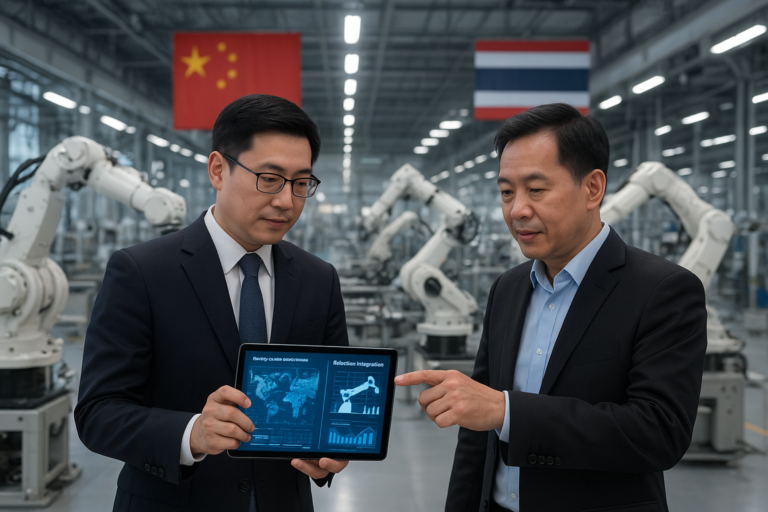
The key signal is China’s targeted investment in robotics within Thailand’s supply chain ecosystem, reflecting a strategic pivot toward automation and advanced manufacturing in the region. For investors focused on ASEAN markets, this development extends beyond technology adoption; it signals enhanced integration of Thailand into China’s evolving industrial strategy that emphasizes robotics to improve supply chain resilience and efficiency. Understanding this dynamic is crucial for positioning within sectors exposed to manufacturing modernization and ASEAN supply chain realignment.
This shift matters because it reframes Thailand’s role from a traditional low-cost assembly hub to a more technologically sophisticated production base. As Chinese capital and technology increasingly embed within Thai manufacturing, particularly in robotics, several sectors will experience transformative impacts, including electronics, automotive, and industrial machinery. The integration also impacts capital flows, technology transfer, and operational cost structures, thereby affecting investor risk and return profiles linked to Thailand’s export-driven economy.
Key Facts
- China has increased its investment focus on robotics technology within Thailand’s supply chains.
- These investments are aimed at integrating robotics to enhance manufacturing productivity and flexibility.
- The initiative reflects China’s broader strategy to export advanced manufacturing capabilities abroad, particularly within ASEAN.
- The direct investment involves both technology deployment and capital infusion targeting Thai industrial sectors.
Why It Matters
China’s robotics investment signals a structural upgrade in Thailand’s manufacturing landscape, which has long been a cornerstone of its economic model. By embedding robotics technology, Thai manufacturers can enhance operational efficiency and competitiveness, particularly in export-oriented sectors. This upgrade is critical against rising wage pressures in Thailand and increased global competition, as automation can offset labor cost inflation and productivity bottlenecks.
Economically, this development suggests a gradual shift toward value-added manufacturing, which has implications for Thailand’s export mix and industrial productivity. Investors should note that such technological integration likely raises the bar for competitiveness, potentially benefiting larger firms capable of absorbing upfront costs while challenging smaller suppliers.
On a business level, the influx of Chinese robotics technology obliges supply chain participants to adapt to new operational standards, software interfaces, and maintenance practices, elevating the demand for skilled labor and technical training. This retooling process will impact cost structures and human capital deployment within Thai industries.
Investment Implications
The deployment of Chinese robotics investment in Thailand intensifies the attractiveness of the manufacturing sector, particularly within subsectors focused on electronics and automotive parts, where precision and automation drive value. Foreign and domestic investors with exposure to Thai listed companies involved in these supply chains may see shifts in capital expenditure patterns, including increases in automation investments and upgrades to robotics.
Additionally, the interplay between Chinese capital and Thai manufacturing firms may accelerate technology diffusion which could broaden the industrial base and refine Thailand’s export quality. However, initial capital investment intensity and workforce retraining requirements may introduce transitional risks and increased short-term operational costs.
The trend also refocuses capital allocation considerations on sectors that can leverage robotics-enhanced productivity gains versus those reliant on low-cost manual labor. This reorientation may impact borrowing costs and valuation multiples for firms depending on their adaptability to automation underpinned by Chinese technology investment.
Sector Impact
Positive
- Manufacturing: Robotics integration supports enhanced productivity and quality, particularly in electronics and automotive supply chains.
- Industrial Machinery: Increased demand for robotics maintenance, software, and upgrades creates growth opportunities.
Neutral
- Logistics: While automation may improve internal processes, broader structural changes remain limited in the short term.
Risk
- Labor-Intensive Sectors: Increased automation may create displacement pressures and require workforce reskilling, impacting related employment sectors negatively.
- Small and Medium Enterprises (SMEs): SMEs with limited capital to invest in robotics may face competitiveness challenges.
Strategic Signals
This development signals Thailand’s shifting industrial strategy towards embracing advanced manufacturing technologies to sustain relevance within global and regional supply chains dominated by China’s technological ascendancy. It confirms Thailand’s growing role as a strategic manufacturing node within China’s China+1 model, where investment is used to diversify production bases while maintaining integration with Chinese technology and capital.
Second-order effects include the potential for expanded regional technology clusters centered around robotics and automation, leading to increased demand for technical education, innovation hubs, and infrastructure upgrades aligned with Industry 4.0 standards. This dynamic also suggests a deeper interdependence between Thai manufacturing and Chinese capital cycles, incorporating technology-intensive production into the ASEAN supply chain fabric.
ASEAN Context
The robotics investment by China in Thailand reflects the broader regional trend where ASEAN is becoming a pivotal battleground for supply chain upgrades and technological leapfrogging. Thailand’s early position as the recipient of such investment enhances its competitiveness relative to neighboring ASEAN economies in attracting follow-on investments and talent in advanced manufacturing.
This bolstered technological integration tightens Thailand’s supply chain linkages with China, fortifying the ASEAN-China trade and investment axis. It also elevates Thailand’s role as a gateway for the diffusion of robotics technology and automation best practices across ASEAN manufacturing hubs.
Risks
The principal risk lies in execution challenges, including the integration of advanced robotics within existing Thai manufacturing ecosystems that may not be uniformly prepared for such transformation. Mismatches in workforce skills and infrastructure readiness could slow adoption and limit immediate productivity gains.
There is also risk around capital concentration, where dependence on Chinese technology investment may create strategic vulnerabilities or limit diversification of supply chain partners.
Smaller firms face heightened risk from increased automation-related costs, potentially leading to market consolidation favoring well-capitalized enterprises. These factors contribute to uneven sectoral impacts and volatility in company earnings tied to automation investments.
Bottom Line
China’s robotics investment in Thailand marks a strategic evolution toward automated, high-tech manufacturing embedded within ASEAN supply chains. This elevates Thailand’s industrial competitiveness but introduces transitional capital and human resource challenges. Investors should consider the durable shift in Thailand’s manufacturing base and how sectoral exposures align with increasing automation driven by Chinese technology infusion. The development positions Thailand as a critical node within China’s regional industrial upgrades, shaping future capital flows and operational strategies in ASEAN manufacturing.
Thailand Investor Brief
Stay Ahead of Thailand and ASEAN Markets
Explore Thailand Signal Capital’s flagship investor intelligence service,
including free market insights and premium daily briefings for investors,
executives, entrepreneurs, and ASEAN-focused professionals.
- Thailand and ASEAN market intelligence
- Investment implications and strategic signals
- FREE and PRO briefing options
Frequently Asked Questions
Why does this development matter for Thailand investors?
This development matters because it may affect Thailand’s investment
environment through policy direction, sector exposure, trade dynamics,
capital allocation, or ASEAN market positioning.
Which sectors could be affected?
The most relevant sectors depend on the specific development, but investors
should assess exposure across policy-sensitive industries, financial
services, trade-linked sectors, infrastructure, property, tourism, energy,
and ASEAN-facing businesses.
How does this affect Thailand’s position in ASEAN?
The ASEAN impact depends on whether the development changes regional
competitiveness, cross-border investment, supply chains, or investor
sentiment. Thailand’s role should be assessed relative to nearby markets
such as Singapore, Malaysia, Vietnam, Indonesia, and Cambodia.
What should investors watch next?
Investors should watch implementation details, policy follow-through,
sector-level responses, corporate earnings signals, regulatory changes,
and whether the development creates measurable shifts in demand, costs,
or capital flows.
Complete Guide
For a broader investment framework, continue with the Thailand Tourism Investment Guide 2026.