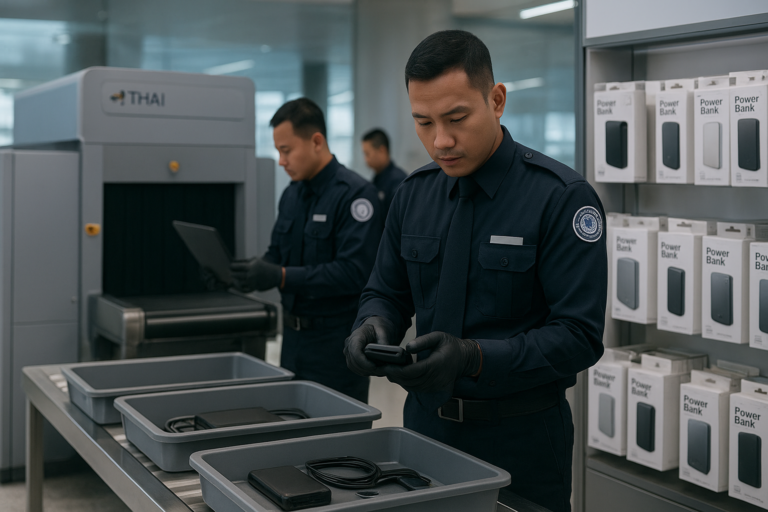
Executive Summary
The key signal is the tightening of power bank flight regulations, which underscores increasing safety and compliance priorities in Thailand’s aviation and consumer electronics sectors. This development signals heightened regulatory scrutiny that will influence supply chain management, consumer behavior, and airport security protocols, with direct consequences for businesses involved in travel, retail, and tech manufacturing. Investors attentive to these adjustments will find implications for cost structures, market access, and operational compliance within Thailand’s broader transportation and electronics markets.
Key Facts
- New or reinforced flight regulations in Thailand restrict or impose conditions on carrying power banks onboard aircraft.
- These restrictions align with international safety concerns regarding lithium-ion batteries and potential fire risks during air transport.
- Impact extends across passenger travel, air cargo logistics, and retail sales of portable battery products.
Why It Matters
For Thailand, heightened power bank flight regulations reflect both alignment with global aviation safety standards and an evolving regulatory environment that affects multiple sectors. These rules impact the aviation industry’s operational protocols, particularly at major hubs such as Bangkok’s Suvarnabhumi and Don Mueang airports, where compliance necessitates updated screening technology and staff training, potentially raising operating costs.
More broadly, the consumer electronics market confronts constraints on product design, packaging, and marketing. Retailers and manufacturers must navigate these controls to maintain market access and customer convenience, especially as power banks constitute a significant segment of mobile accessory sales. For companies integrated into ASEAN supply chains, regulatory harmonization with partners becomes critical, as discrepancies can disrupt cross-border logistics and inventory management.
For investors, power bank restrictions illuminate emerging risk factors including compliance costs and potential dampening of consumer demand for portable charging devices. This shift requires asset owners in airport infrastructure, retail chains, and electronics manufacturing to re-evaluate operational risk profiles and cost implications, factoring in both direct regulatory expenses and indirect demand effects.
Sector Impact
Positive:
- Aviation Security: Enhanced focus on safety standards may drive investment in advanced screening and fire prevention technologies, expanding opportunities for security technology providers.
Neutral:
- Airports: While regulatory compliance adds operational layers, the impact is balanced by maintaining safety reputations critical for international travel continuity.
Risk:
- Consumer Electronics: Market restrictions on power banks constrain product varieties and may reduce sales, pressuring manufacturers and retailers reliant on portable power accessories.
- Air Cargo and Logistics: Additional oversight and packaging requirements increase costs and complexity in handling lithium-ion battery shipments, influencing profitability.
ASEAN Context
This development appears primarily domestic in nature with limited immediate ASEAN-wide implications, but it reinforces the necessity for regulatory convergence on lithium battery transport safety across the region. Variations in enforcement across ASEAN could create competitive disparities for Thailand-based manufacturers and logistics firms engaged in intra-regional trade of consumer electronics, necessitating close attention to regional standards integration.
Bottom Line
Power bank flight regulations represent a crucial intersection of safety imperatives and commercial activity in Thailand. Investors with exposure to aviation infrastructure and consumer electronics sectors must incorporate these evolving compliance demands into operational and strategic planning. The direct impact on cost structures and customer accessibility underscores the importance of emphasizing security innovation and supply chain adaptability. Ultimately, maintaining competitive positioning in Thailand’s dynamic travel and retail markets will hinge on proactive compliance and technological responsiveness.
Thailand Investor Brief
Want deeper Thailand & ASEAN investor intelligence?
Join Thailand Investor Brief FREE
Unlock Thailand Investor Brief PRO
Complete Guide
For a broader investment framework, continue with the Thailand Tourism Investment Guide 2026.