Executive Summary
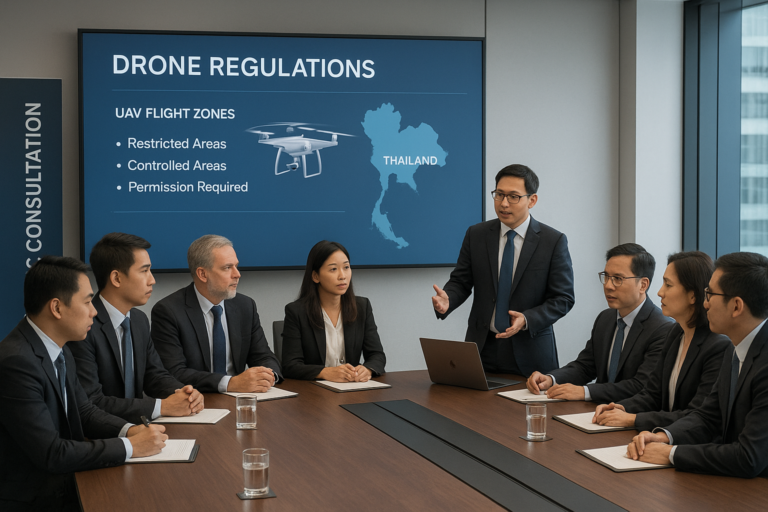
The key signal is Thailand’s National Broadcasting and Telecommunications Commission (NBTC) soliciting public feedback on drone regulations, highlighting a proactive regulatory approach to integrating emerging drone technology within Thailand’s policy framework. This matters because evolving drone regulations will shape operational compliance, market entry, investment risk profiles, and innovation pathways across multiple sectors in Thailand’s fast-growing drone ecosystem, affecting investors and businesses reliant on or integrating drones in commercial activities.
Key Facts
- Thailand’s NBTC has opened a public consultation seeking feedback on drone-related regulations.
- The consultation is aimed at establishing clearer rules for drone operations and uses within Thailand.
- No explicit details on regulatory changes or frameworks under consideration were provided.
Why It Matters
This development signals a regulatory environment adjusting to technological advances and the rising prominence of unmanned aerial vehicles (UAVs) in Thailand’s economy. For investors, the clarification and potential tightening or liberalization of drone governance reduces regulatory uncertainty, impacting investment valuations, operational feasibility, and competitive dynamics in drone-related ventures.
Thailand’s drone sector interfaces with multiple economic domains—from logistics and agriculture to security and telecommunications infrastructure inspection. Updated regulations can influence capital expenditure allocation for listed companies engaged in drone manufacturing, software, and service provision, as well as foreign and domestic investors evaluating market entry or expansion.
Policy clarity on drone use also matters for compliance costs, safety protocols, and privacy norms, factors critical to business planning in aviation-related or data-sensitive sectors. The move to involve public opinion demonstrates a recognition of balancing innovation facilitation with risk management, which underpins sustainable growth in drone applications.
Given Thailand’s ambition to be a technology hub in ASEAN, establishing a transparent and responsive regulatory framework for drones facilitates ecosystem development, promotes investor confidence, and aligns with international standards, enhancing cross-border collaborations and technology transfer opportunities.
Sector Impact
Positive:
- Technology & Telecommunications: Enhanced clarity and structured regulations encourage investment in drone technologies, fostering innovation and integration into telecom network infrastructure management.
- Logistics & E-Commerce: Improved regulatory framework supports expansion of drone delivery services, boosting operational efficiency and service reach.
- Agriculture: Clearer drone policies can accelerate adoption of precision agriculture technologies, improving productivity.
Neutral:
- Manufacturing & Aerospace: Existing operations may see limited immediate changes until specific regulations are formalized; the consultation phase indicates no abrupt shifts.
Risk:
- Security & Privacy-Sensitive Sectors: Possible increased compliance costs and operational restrictions depending on final regulation, elevating risk profiles.
- General Aviation: Stricter drone regulations could pose airspace coordination challenges, potentially affecting air traffic management and costs.
ASEAN Context
This development aligns Thailand with a broader ASEAN trend toward formalizing UAV policies to govern commercial and civil drone use, essential for regional interoperability and cross-border drone operations. Enhanced Thai regulations may attract ASEAN-based drone businesses seeking a regulatory-compliant hub. It also underscores Thailand’s positioning as a proactive player within Southeast Asia’s emerging drone ecosystem, contributing to harmonization efforts that support regional supply chains and technology exchange.
Bottom Line
Thailand’s NBTC-led public consultation on drone regulations signals a critical juncture for regulatory evolution in drone policy, providing clearer direction that underpins investment decisions and business operations in drone-related activities. Clarity and balance in regulation will enhance sector growth, reduce uncertainty, and integrate Thailand’s drone economy into broader ASEAN initiatives. Investors and market participants should recalibrate risk assessments and strategic plans to incorporate this advancing regulatory backdrop.
Stay Ahead of Thailand and ASEAN Markets
Thailand Investor Brief delivers AI-powered investor intelligence covering Thailand’s economy, markets, policy developments, and ASEAN business trends.
Receive daily insights designed for investors, executives, entrepreneurs, and globally minded professionals.
Join thousands of readers following the signals that matter across Thailand and ASEAN.
Join Thailand Investor Brief FREE
Complete Guide
For a broader investment framework, continue with the Thailand Energy Investment Guide 2026.